
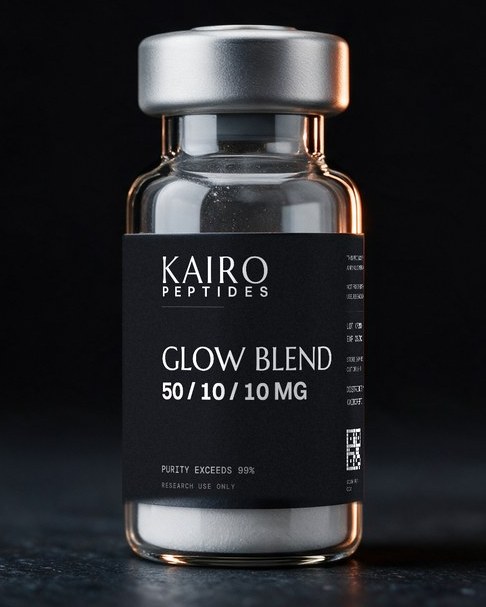
GLOW Blend
50MG/10MG/10MGSupplied together: pull from 1 vial instead of 3. Studied for wound closure, collagen and the extracellular matrix, new blood vessel formation, tendon repair and inflammation, each by one of the 3 peptides in this vial on its own. The combination itself has never been studied. Every paper behind those is linked below.
$110.00
- COA WITH EVERY BATCH
- 3RD-PARTY VERIFIED
| Title | Range | Discount |
|---|---|---|
| Pack tier: GLOW Blend (KAIRO-GLOW-BLEND-50MG) | 1 - 2 | $110.00 |
| Pack of 3+: 10% off | 3 - 4 | $99.00 |
| Pack of 5+: 15% off | 5 - 9 | $93.50 |
| Pack of 10+: 20% off | 10 + | $88.00 |
For laboratory research use only. Not for human or veterinary use, not for diagnostic or therapeutic use, and not for food or drug manufacture. No preparation or usage guidance is provided anywhere on this page.
1 vial instead of 3.
Pull from 1 vial instead of 3, and read each compound on its own: GHK-Cu, BPC-157 and TB-500 have not been studied together, so every claim below belongs to a single compound.
-
GHK-Cu
Preclinical strong Either convergent results from more than one independent laboratory across more than one experimental system, or a randomized controlled trial in people. The rating describes the evidence behind one finding, in the species, model and route it was measured in. It never means the finding transfers to this material's format, and it never means the combination in this vial was studied.GHK-Cu is studied for wound closure, and in a randomized human trial a topical gel reached 98.5 percent healing against 60.8 percent for the vehicle alone.
GHK-Cu: randomized human trial, topical gel on open ulcers Full GHK-Cu profile
-
BPC-157
Preclinical moderate A well-described result with several independent outcome measures, but from a single laboratory or a single study design.BPC-157 is studied for tendon healing, reported in rats to help a surgically cut Achilles tendon regain more of its strength.
BPC-157: surgically cut rat Achilles tendon Full BPC-157 profile
-
TB-500
Preclinical moderate A well-described result with several independent outcome measures, but from a single laboratory or a single study design.Thymosin beta-4, the protein TB-500 is drawn from, is studied in a mouse heart injury model, reported to help heart-muscle cells survive and improve heart function.
Thymosin beta-4: mouse heart injury model Full TB-500 profile
Each line above belongs to a single component, tested on its own. No study has tested GHK-Cu, BPC-157 and TB-500 given together, so nothing here is a claim about the blend.
Frequently paired with
What shoppers usually add alongside this one
A versatile peptide, studied in research on cell movement and tissue repair.
A recovery-focused blend, studied in research on tissue repair.
What the research says about pairing these
BPC-157 with TB-500 (the core pairing)
The most commonly co-marketed repair pairing. The stated rationale is that the two components are studied on different axes: BPC-157 in angiogenesis and tissue-repair models, TB-500 and thymosin beta-4 in actin regulation and cell migration. That is a rationale assembled from two separate literatures, not a finding about the pair.
Europe PMC, which indexes PubMed and PMC, was searched on July 28, 2026 with the queries '"BPC 157" AND "TB-500"' (12 records) and '"BPC 157" AND "thymosin beta 4"' (15 records). Every returned record was a narrative review, a scoping or banned-substance review, or a commentary that mentions the two compounds side by side; none was a controlled study of the two in combination. The individual preclinical evidence is real; the pairing rationale is inferred from separate mechanisms and no combination study was found within that coverage.
GHK-Cu added to BPC-157 and TB-500 (the full three-component blend)
GHK-Cu carries a separately studied extracellular-matrix and collagen-turnover literature, positioned in the market as complementary to the other 2. Each component's research stands alone. The triad is formulation logic, not a studied intervention.
Europe PMC was searched on July 28, 2026 with '"BPC-157" AND "GHK-Cu"' (11 records) and '("GHK-Cu" OR "GHK copper") AND "TB-500"' (8 records). All returned records were narrative reviews or commentary listing the compounds together; none was a combination or head-to-head study, and none tested the three-component combination as a unit.
-
Studied for
GHK-Cu: randomized human trial, topical gel on open ulcers
A multicenter, randomized, evaluator-blinded, placebo-controlled trial tested a topical GHK-Cu gel on open ulcers, with everyone enrolled also on an aggressive standardized wound-care protocol. The published abstract reports that the gel significantly increased the percentage of closure of plantar ulcers, 98.5 percent median area percentage closure versus 60.8 percent for vehicle (p less than 0.05), and that the rate of closure was three times faster with the gel compared with standard care and vehicle. This is a single 1994 trial of a gel applied to open ulcers. It describes no other route, format or population, and it is not evidence about this blend. The population and setting are named in full in the citation title, which is reproduced verbatim. HUMAN in a randomized, evaluator-blinded, placebo-controlled human trial using a topical gel on open ulcers Preclinical strong Either convergent results from more than one independent laboratory across more than one experimental system, or a randomized controlled trial in people. The rating describes the evidence behind one finding, in the species, model and route it was measured in. It never means the finding transfers to this material's format, and it never means the combination in this vial was studied. Open for the full finding and the paper it came from.In the literatureGHK-Cu: randomized human trial, topical gel on open ulcers
A multicenter, randomized, evaluator-blinded, placebo-controlled trial tested a topical GHK-Cu gel on open ulcers, with everyone enrolled also on an aggressive standardized wound-care protocol. The published abstract reports that the gel significantly increased the percentage of closure of plantar ulcers, 98.5 percent median area percentage closure versus 60.8 percent for vehicle (p less than 0.05), and that the rate of closure was three times faster with the gel compared with standard care and vehicle. This is a single 1994 trial of a gel applied to open ulcers. It describes no other route, format or population, and it is not evidence about this blend. The population and setting are named in full in the citation title, which is reproduced verbatim.References 1
Modelin a randomized, evaluator-blinded, placebo-controlled human trial using a topical gel on open ulcers
-
Studied for
Thymosin beta-4: actin-sequestering biochemistry
Thymosin beta-4 was shown to be indistinguishable from Fx, the actin-sequestering peptide that holds most of the unpolymerized actin in resting human platelets: the complete amino acid sequence of Fx was determined and found identical to thymosin beta-4. It forms a 1:1 complex with actin monomers and inhibits polymerization. The authors note that its widespread distribution and high intracellular concentration strongly suggest a significant role in regulating actin polymerization in many cell types. This is established cell biochemistry, not a tissue-repair outcome. IN VITRO biochemical work with purified peptide and purified actin (in vitro), from human platelets Preclinical strong Either convergent results from more than one independent laboratory across more than one experimental system, or a randomized controlled trial in people. The rating describes the evidence behind one finding, in the species, model and route it was measured in. It never means the finding transfers to this material's format, and it never means the combination in this vial was studied. Open for the full finding and the paper it came from.In the literatureThymosin beta-4: actin-sequestering biochemistry
Thymosin beta-4 was shown to be indistinguishable from Fx, the actin-sequestering peptide that holds most of the unpolymerized actin in resting human platelets: the complete amino acid sequence of Fx was determined and found identical to thymosin beta-4. It forms a 1:1 complex with actin monomers and inhibits polymerization. The authors note that its widespread distribution and high intracellular concentration strongly suggest a significant role in regulating actin polymerization in many cell types. This is established cell biochemistry, not a tissue-repair outcome.References 2
Modelbiochemical work with purified peptide and purified actin (in vitro), from human platelets
-
Studied for
TB-500 and thymosin beta-4: what the literature actually contains
A 2026 scoping review searched PubMed, Europe PMC and ClinicalTrials.gov through March 2026, screened 1,772 records and included 80 studies. Its conclusions are deflationary rather than promotional. The evidence base was weighted toward mixed and in vitro designs, and most studies evaluated thymosin beta-4 rather than TB-500, with direct TB-500 evidence limited to a single included study. The most common tissue categories were wound and skin and soft tissue, vascular and endothelial, ocular and cornea, and bone; direct musculoskeletal categories such as tendon, ligament, muscle, cartilage and spine were comparatively sparse. Human evidence was concentrated in eye and skin settings. The authors conclude that the mapped literature remains unevenly distributed and largely preclinical, with limited human evidence directly relevant to musculoskeletal applications. That sentence is the reason nothing on this page is written as a musculoskeletal claim. IN VITRO a scoping review of in vitro, animal and limited human studies Preclinical strong Either convergent results from more than one independent laboratory across more than one experimental system, or a randomized controlled trial in people. The rating describes the evidence behind one finding, in the species, model and route it was measured in. It never means the finding transfers to this material's format, and it never means the combination in this vial was studied. Open for the full finding and the paper it came from.In the literatureTB-500 and thymosin beta-4: what the literature actually contains
A 2026 scoping review searched PubMed, Europe PMC and ClinicalTrials.gov through March 2026, screened 1,772 records and included 80 studies. Its conclusions are deflationary rather than promotional. The evidence base was weighted toward mixed and in vitro designs, and most studies evaluated thymosin beta-4 rather than TB-500, with direct TB-500 evidence limited to a single included study. The most common tissue categories were wound and skin and soft tissue, vascular and endothelial, ocular and cornea, and bone; direct musculoskeletal categories such as tendon, ligament, muscle, cartilage and spine were comparatively sparse. Human evidence was concentrated in eye and skin settings. The authors conclude that the mapped literature remains unevenly distributed and largely preclinical, with limited human evidence directly relevant to musculoskeletal applications. That sentence is the reason nothing on this page is written as a musculoskeletal claim.References 3
Modela scoping review of in vitro, animal and limited human studies
-
Studied for
GHK-Cu: wound repair in animal models
The Pickart review reports that in animal experiments GHK-Cu accelerated wound healing and increased blood vessel formation and the level of antioxidant enzymes in rabbits; that it induced systemic wound healing in rats, mice and pigs; and that it improved the healing of impaired and ischemic wounds in rats while lowering TNF-alpha and stimulating collagen synthesis. These are animal results reported secondhand inside a review; the underlying primary studies were not independently resolved here, and no human outcome is implied. in rabbit, rat, mouse and pig studies, as summarized in a peer-reviewed review Preclinical moderate A well-described result with several independent outcome measures, but from a single laboratory or a single study design. Open for the full finding and the paper it came from.In the literatureGHK-Cu: wound repair in animal models
The Pickart review reports that in animal experiments GHK-Cu accelerated wound healing and increased blood vessel formation and the level of antioxidant enzymes in rabbits; that it induced systemic wound healing in rats, mice and pigs; and that it improved the healing of impaired and ischemic wounds in rats while lowering TNF-alpha and stimulating collagen synthesis. These are animal results reported secondhand inside a review; the underlying primary studies were not independently resolved here, and no human outcome is implied.References 4
Modelin rabbit, rat, mouse and pig studies, as summarized in a peer-reviewed review
-
Studied for
BPC-157: surgically cut rat Achilles tendon
In rats whose right Achilles tendon was surgically cut through, leaving a gap between the cut ends, BPC-157 given starting 30 minutes after surgery and assessed on days 1, 4, 7, 10 and 14 produced, compared with saline controls: higher load of failure, higher load of failure per area and higher Young's modulus of elasticity; significantly better Achilles functional index scores; more mononuclear cells and fewer granulocytes with better formation of fibroblasts, reticulin and collagen on microscopy; and a smaller, shallower tendon defect. In parallel cell culture, BPC-157 had no effect on cell growth on its own but reversed the growth-inhibiting effect of 4-hydroxynonenal on tendon cells. The paper's own conclusion is a case for further investigation rather than an established use. in a rat surgical model, plus cultured tendon cells Preclinical moderate A well-described result with several independent outcome measures, but from a single laboratory or a single study design. Open for the full finding and the paper it came from.In the literatureBPC-157: surgically cut rat Achilles tendon
In rats whose right Achilles tendon was surgically cut through, leaving a gap between the cut ends, BPC-157 given starting 30 minutes after surgery and assessed on days 1, 4, 7, 10 and 14 produced, compared with saline controls: higher load of failure, higher load of failure per area and higher Young's modulus of elasticity; significantly better Achilles functional index scores; more mononuclear cells and fewer granulocytes with better formation of fibroblasts, reticulin and collagen on microscopy; and a smaller, shallower tendon defect. In parallel cell culture, BPC-157 had no effect on cell growth on its own but reversed the growth-inhibiting effect of 4-hydroxynonenal on tendon cells. The paper's own conclusion is a case for further investigation rather than an established use.References 5
Modelin a rat surgical model, plus cultured tendon cells
-
Studied for
BPC-157: how much of this is preclinical, and how thin the human evidence is
A 2026 narrative review describes BPC-157 as a synthetic pentadecapeptide derived from gastric proteins that has shown reparative and anti-inflammatory properties across diverse preclinical models, with experimental evidence that it supports angiogenesis, collagen synthesis, fibroblast activity and modulation of nitric oxide pathways. The review is equally explicit about the other side: human research remains limited to small pilot studies, inconsistent preparation standards and limited clinical validation underscore the need for rigorous controlled trials, and comprehensive evaluation is required before clinical translation can be recommended. IN VITRO a review of predominantly animal and in vitro studies, with human evidence limited to small pilot studies Preclinical moderate A well-described result with several independent outcome measures, but from a single laboratory or a single study design. Open for the full finding and the paper it came from.In the literatureBPC-157: how much of this is preclinical, and how thin the human evidence is
A 2026 narrative review describes BPC-157 as a synthetic pentadecapeptide derived from gastric proteins that has shown reparative and anti-inflammatory properties across diverse preclinical models, with experimental evidence that it supports angiogenesis, collagen synthesis, fibroblast activity and modulation of nitric oxide pathways. The review is equally explicit about the other side: human research remains limited to small pilot studies, inconsistent preparation standards and limited clinical validation underscore the need for rigorous controlled trials, and comprehensive evaluation is required before clinical translation can be recommended.References 6
Modela review of predominantly animal and in vitro studies, with human evidence limited to small pilot studies
-
Studied for
Thymosin beta-4: mouse heart injury model
Thymosin beta-4 promoted myocardial and endothelial cell migration in the embryonic heart and retained that property in postnatal heart muscle cells, and improved survival of embryonic and postnatal heart muscle cells in culture. The researchers found it formed a functional complex with the proteins PINCH and integrin-linked kinase, which activated the survival kinase Akt. After a coronary artery was tied off in mice, thymosin beta-4 raised integrin-linked kinase and Akt activity in the heart, improved early heart-muscle-cell survival and improved cardiac function. The authors frame the pathway as a possible new therapeutic target, not as an established use. in mice after coronary artery ligation, plus cultured heart cells Preclinical moderate A well-described result with several independent outcome measures, but from a single laboratory or a single study design. Open for the full finding and the paper it came from.In the literatureThymosin beta-4: mouse heart injury model
Thymosin beta-4 promoted myocardial and endothelial cell migration in the embryonic heart and retained that property in postnatal heart muscle cells, and improved survival of embryonic and postnatal heart muscle cells in culture. The researchers found it formed a functional complex with the proteins PINCH and integrin-linked kinase, which activated the survival kinase Akt. After a coronary artery was tied off in mice, thymosin beta-4 raised integrin-linked kinase and Akt activity in the heart, improved early heart-muscle-cell survival and improved cardiac function. The authors frame the pathway as a possible new therapeutic target, not as an established use.References 7
Modelin mice after coronary artery ligation, plus cultured heart cells
-
Studied for
Thymosin beta-4: randomized human trials, eye drops
In a single-center, prospective, double-masked, placebo-controlled Phase II trial that randomized 72 subjects with moderate to severe dry eye for 28 days using a controlled adverse environment model, topical thymosin beta-4 eye drops failed on both primary endpoints: neither ocular discomfort nor inferior corneal staining showed a significant difference versus placebo. Several secondary endpoints did differ: discomfort scores in the controlled adverse environment on day 28 were 27 percent lower in the group given the drops (P=0.0244), and central and superior corneal staining improved significantly (P=0.0075 and P=0.0210). No adverse events were observed. A separate, much smaller multicenter Phase 2 trial in 9 participants with severe dry eye reported at day 56 a 35.1 percent reduction in ocular discomfort and a 59.1 percent reduction in total corneal fluorescein staining versus vehicle control. Both are eye-drop studies of thymosin beta-4 rather than of TB-500; the larger one missed its primary endpoints, and the smaller one is very small. Neither says anything about this blend's format or about tissue repair elsewhere in the body. HUMAN in randomized, double-masked, placebo-controlled human trials using topical eye drops Preclinical moderate A well-described result with several independent outcome measures, but from a single laboratory or a single study design. Open for the full finding and the paper it came from.In the literatureThymosin beta-4: randomized human trials, eye drops
In a single-center, prospective, double-masked, placebo-controlled Phase II trial that randomized 72 subjects with moderate to severe dry eye for 28 days using a controlled adverse environment model, topical thymosin beta-4 eye drops failed on both primary endpoints: neither ocular discomfort nor inferior corneal staining showed a significant difference versus placebo. Several secondary endpoints did differ: discomfort scores in the controlled adverse environment on day 28 were 27 percent lower in the group given the drops (P=0.0244), and central and superior corneal staining improved significantly (P=0.0075 and P=0.0210). No adverse events were observed. A separate, much smaller multicenter Phase 2 trial in 9 participants with severe dry eye reported at day 56 a 35.1 percent reduction in ocular discomfort and a 59.1 percent reduction in total corneal fluorescein staining versus vehicle control. Both are eye-drop studies of thymosin beta-4 rather than of TB-500; the larger one missed its primary endpoints, and the smaller one is very small. Neither says anything about this blend's format or about tissue repair elsewhere in the body.References 8, 9
Modelin randomized, double-masked, placebo-controlled human trials using topical eye drops
-
Studied for
GHK-Cu: extracellular-matrix and collagen turnover
In cultured cells, GHK-Cu at very low, non-toxic concentrations stimulated both the making and the breaking down of collagen and glycosaminoglycans, and stimulated collagen, dermatan sulfate, chondroitin sulfate and the small proteoglycan decorin. The review's own words are 'both synthesis and breakdown', which means turnover, not one-directional collagen building. A separate sentence in the same review attributes modulation of matrix metalloproteinases and their inhibitors TIMP-1 and TIMP-2 to GHK, the copper-free tripeptide, not to GHK-Cu; that distinction is preserved here rather than merged. IN VITRO in cultured cells (in vitro), as summarized in a peer-reviewed review Preclinical preliminary A single study, an early mechanistic observation, or a result whose interpretation is the authors' own inference. Open for the full finding and the paper it came from.In the literatureGHK-Cu: extracellular-matrix and collagen turnover
In cultured cells, GHK-Cu at very low, non-toxic concentrations stimulated both the making and the breaking down of collagen and glycosaminoglycans, and stimulated collagen, dermatan sulfate, chondroitin sulfate and the small proteoglycan decorin. The review's own words are 'both synthesis and breakdown', which means turnover, not one-directional collagen building. A separate sentence in the same review attributes modulation of matrix metalloproteinases and their inhibitors TIMP-1 and TIMP-2 to GHK, the copper-free tripeptide, not to GHK-Cu; that distinction is preserved here rather than merged.References 4
Modelin cultured cells (in vitro), as summarized in a peer-reviewed review
-
Studied for
GHK-Cu: topical cosmetic studies reported secondhand inside the review
The Pickart review describes two different topical human studies that are often merged and should not be. First, a study that applied creams to the thigh for one month and read collagen production from skin biopsies using immunohistological techniques: increases were found in 70 percent of the women who used the GHK-Cu cream, versus 50 percent for a vitamin C cream and 40 percent for retinoic acid. The review attributes this to Abdulghani et al. 1998, whose own title calls it a pilot clinical, histologic and ultrastructural study. Second, a separate 12-week facial-cream study in 71 women, which assessed visible skin parameters and did not measure collagen. The review attributes that one to a Leyden et al. presentation at an American Academy of Dermatology meeting in February 2002, a conference proceeding rather than a peer-reviewed paper. Both are stated here strictly as reported inside the review; the review was resolved, the two primaries were not. in human topical cosmetic studies, described secondhand within a peer-reviewed review; one primary is a pilot study and the other is a conference presentation Preclinical preliminary A single study, an early mechanistic observation, or a result whose interpretation is the authors' own inference. Open for the full finding and the paper it came from.In the literatureGHK-Cu: topical cosmetic studies reported secondhand inside the review
The Pickart review describes two different topical human studies that are often merged and should not be. First, a study that applied creams to the thigh for one month and read collagen production from skin biopsies using immunohistological techniques: increases were found in 70 percent of the women who used the GHK-Cu cream, versus 50 percent for a vitamin C cream and 40 percent for retinoic acid. The review attributes this to Abdulghani et al. 1998, whose own title calls it a pilot clinical, histologic and ultrastructural study. Second, a separate 12-week facial-cream study in 71 women, which assessed visible skin parameters and did not measure collagen. The review attributes that one to a Leyden et al. presentation at an American Academy of Dermatology meeting in February 2002, a conference proceeding rather than a peer-reviewed paper. Both are stated here strictly as reported inside the review; the review was resolved, the two primaries were not.References 4
Modelin human topical cosmetic studies, described secondhand within a peer-reviewed review; one primary is a pilot study and the other is a conference presentation
-
Studied for
GHK: gene-expression database analysis
Using the Broad Institute's Connectivity Map, a software gene-profiling tool, GHK was reported to significantly increase the expression of DNA-repair genes, with 47 genes stimulated and 5 genes suppressed at a threshold of at least a 50 percent increase or decrease. This is a computational database analysis, not an experiment in tissue. The same review's abstract also asserts a whole-genome regulatory effect for GHK; on a direct reading of the full text the review supplies no underlying study or methodology for that figure, so it is not reported as a result here. The review's accompanying framing of the result is the authors' own language rather than a finding, and is excluded. in a computational transcriptomic database analysis (Connectivity Map); the review specifies no cell type Preclinical preliminary A single study, an early mechanistic observation, or a result whose interpretation is the authors' own inference. Open for the full finding and the paper it came from.In the literatureGHK: gene-expression database analysis
Using the Broad Institute's Connectivity Map, a software gene-profiling tool, GHK was reported to significantly increase the expression of DNA-repair genes, with 47 genes stimulated and 5 genes suppressed at a threshold of at least a 50 percent increase or decrease. This is a computational database analysis, not an experiment in tissue. The same review's abstract also asserts a whole-genome regulatory effect for GHK; on a direct reading of the full text the review supplies no underlying study or methodology for that figure, so it is not reported as a result here. The review's accompanying framing of the result is the authors' own language rather than a finding, and is excluded.References 4
Modelin a computational transcriptomic database analysis (Connectivity Map); the review specifies no cell type
-
Studied for
GHK: antioxidant characterization
The review characterizes GHK as able to quench some toxins, in particular those generated during lipid peroxidation, which it says makes GHK a quite efficient antioxidant, and states that GHK helps reduce the level of free ionic copper, which the authors relate to preventing oxidative damage. This is biochemical characterization of the molecule, not a demonstrated outcome in a living organism. biochemical characterization described in a peer-reviewed review; no animal or human outcome Preclinical preliminary A single study, an early mechanistic observation, or a result whose interpretation is the authors' own inference. Open for the full finding and the paper it came from.In the literatureGHK: antioxidant characterization
The review characterizes GHK as able to quench some toxins, in particular those generated during lipid peroxidation, which it says makes GHK a quite efficient antioxidant, and states that GHK helps reduce the level of free ionic copper, which the authors relate to preventing oxidative damage. This is biochemical characterization of the molecule, not a demonstrated outcome in a living organism.References 4
Modelbiochemical characterization described in a peer-reviewed review; no animal or human outcome
-
Studied for
BPC-157: tendon cell outgrowth, survival and migration
In rat Achilles tendon explants and isolated tendon fibroblasts grown in a dish, BPC-157 significantly accelerated the outgrowth of cells from tendon explants, significantly increased cell survival under hydrogen peroxide stress, and increased cell migration and spreading, with F-actin formation induced and the FAK and paxillin proteins more phosphorylated. The authors are explicit that cell proliferation itself was not directly affected by BPC-157 as evaluated by MTT assay, so this is a movement-and-survival result, not a cell-multiplication result. IN VITRO EX VIVO in cultured rat tendon cells and tendon explants (in vitro and ex vivo) Preclinical preliminary A single study, an early mechanistic observation, or a result whose interpretation is the authors' own inference. Open for the full finding and the paper it came from.In the literatureBPC-157: tendon cell outgrowth, survival and migration
In rat Achilles tendon explants and isolated tendon fibroblasts grown in a dish, BPC-157 significantly accelerated the outgrowth of cells from tendon explants, significantly increased cell survival under hydrogen peroxide stress, and increased cell migration and spreading, with F-actin formation induced and the FAK and paxillin proteins more phosphorylated. The authors are explicit that cell proliferation itself was not directly affected by BPC-157 as evaluated by MTT assay, so this is a movement-and-survival result, not a cell-multiplication result.References 10
Modelin cultured rat tendon cells and tendon explants (in vitro and ex vivo)
-
Studied for
BPC-157: growth hormone receptor expression in tendon fibroblasts
In tendon fibroblasts isolated from rat Achilles tendon and grown in a dish, a cDNA microarray flagged the growth hormone receptor as one of the most abundantly upregulated genes, and BPC-157 then increased growth hormone receptor expression, time-dependently, at both the mRNA and protein level. When growth hormone was added to cells that had been given BPC-157, proliferation increased and the downstream signaling protein Janus kinase 2 was activated. The authors propose this as a possible mechanism behind their tendon work. No magnitude figure is quoted because none was confirmed in the record resolved. IN VITRO in cultured rat tendon fibroblasts (in vitro) Preclinical preliminary A single study, an early mechanistic observation, or a result whose interpretation is the authors' own inference. Open for the full finding and the paper it came from.In the literatureBPC-157: growth hormone receptor expression in tendon fibroblasts
In tendon fibroblasts isolated from rat Achilles tendon and grown in a dish, a cDNA microarray flagged the growth hormone receptor as one of the most abundantly upregulated genes, and BPC-157 then increased growth hormone receptor expression, time-dependently, at both the mRNA and protein level. When growth hormone was added to cells that had been given BPC-157, proliferation increased and the downstream signaling protein Janus kinase 2 was activated. The authors propose this as a possible mechanism behind their tendon work. No magnitude figure is quoted because none was confirmed in the record resolved.References 11
Modelin cultured rat tendon fibroblasts (in vitro)
3 strong / 5 moderate / 6 preliminaryRated by how many independent labs and how many kinds of experiment found the same thing.
What is in the vial.
A 3-part lyophilized blend.
The full technical write-up 3 paragraphs, plus the fact row
A three-component research-use-only peptide blend. GHK-Cu is the copper(II) complex of the tripeptide glycyl-L-histidyl-L-lysine. BPC-157 is a synthetic 15-amino-acid peptide corresponding to a partial sequence of a protein identified in human gastric juice. TB-500 is a synthetic peptide related to thymosin beta-4. The three are molecules studied in separate bodies of preclinical repair research, packaged together as one formulation.
Searches of Europe PMC (which indexes PubMed and PMC) run on July 28, 2026 for co-occurrence of these compounds returned only narrative reviews and commentary that mention the compounds side by side; no controlled study testing any pairing, and no study testing the three-component combination as a unit, was found within that coverage. The combination is formulation logic, not a studied intervention. The individual literatures are uneven as well. A 2026 scoping review that screened 1,772 records and included 80 studies reports that most of them evaluated thymosin beta-4 rather than TB-500, that direct TB-500 evidence was limited to a single included study, and that the literature it mapped 'remains unevenly distributed and largely preclinical, with limited human evidence directly relevant to musculoskeletal applications.'
Each component has its own scientific literature, and that literature is mostly cells and animals, with a small number of human trials that used routes and formats unrelated to this product. Everything below describes what researchers observed in a laboratory, not what happens to a person. This material is supplied for laboratory research use only, and no preparation or usage guidance is given anywhere on this page.References 3
- Length
- 3 components: GHK-Cu, the copper complex of a 3-residue tripeptide; BPC-157, 15 amino acids; and material sold as TB-500, whose identity is unresolved, against full-length thymosin beta-4 at 43 amino acids
- Proline content
- Not stated. Proline content is a single-molecule property and this material is a 3-component blend.
- Also known as
- Component synonyms: prezatide copper for the GHK-copper complex, and timbetasin, the INN for synthetic thymosin beta-4
- Status
- Not an approved drug in the United States or anywhere else
Sold as a laboratory research material.
Molecular identity
Sequence, formula and registry numbers
- Formula
- Free base Not applicable to a blend, see the component list
- Molar mass
- Free base Not applicable to a blend, see the component list
- CAS
- Free base Not applicable to a blend, see the component list
- PubChem CID
- Free base Not applicable to a blend, see the component list
Any total-mass figure printed on a blend product page is a formulation weight, not a molecular mass. Which GHK-copper species, and which material sold as TB-500, any given lot contains are supplier-specific facts and are not asserted here.References 13, 14, 15, 16, 17, 18, 19
Once it is mixed, it goes in the fridge.
Water is what ages a peptide, so the rules change the moment you add it.
The longer version 3 rows
- Before you mix it
- Supplied as a lyophilized (freeze-dried) powder. Standard laboratory practice for lyophilized research peptides is to hold the sealed vial frozen and dry, commonly at about -4 F (-20 C) for working storage and about -112 F (-80 C) for long-term archival storage, protected from light and heat, and to avoid repeated freeze-thaw cycles, because ice-crystal formation mechanically stresses peptides. That is general practice for this class of material, not a claim attributed to any supplier or brand, and not compound-specific published stability data for this blend.
- Once it is mixed
- Refrigerate the mixed vial at 36 to 46 F (2 to 8 C), on a normal shelf rather than in the freezer or the door. Mixed with bacteriostatic water, the standing window is up to 28 days. That figure is the sterility limit USP <797> assigns to any preserved vial that is entered more than once; it is not a measured chemical stability window for GHK-Cu, BPC-157 or TB-500, and it must never be written as 'stable for 28 days'. Sterile water carries no preservative, so a vial mixed with it is single use. Do not freeze a mixed vial. Nothing in the peer-reviewed record verified for this page establishes a solution-stability window for any of the 3 components. Reconstitution volumes, concentrations, routes, schedules and every other preparation-for-administration detail are withheld: this material is supplied for laboratory research use only.
- In the literature
- One compound-specific property is documented in the peer-reviewed literature rather than inferred, and it concerns the free tripeptide rather than the copper complex. A preformulation study of native GHK reported that the peptide was prone to hydrolytic cleavage when subjected to oxidative stressors, and that it was stable in water in the pH 4.5 to 7.4 buffer range for at least two weeks at 140 F (60 C, as published). Because that study characterizes native GHK, the observation must not be transferred to GHK-Cu, to BPC-157 or to TB-500 without separate data on those molecules, and no such data was located in this verification pass. References 4, 12
Every paper this page is built on.
Click any journal to open the paper.
- Wound Repair and Regeneration
- Journal of Biological Chemistry
- Applied Sciences
- BioMed Research International
- Journal of Orthopaedic Research
- International Journal of Molecular Sciences
- Nature
- Clinical Ophthalmology
- Cornea
- Journal of Applied Physiology
- Molecules
The full list 19 references, each linked
-
1
Mulder GD, Patt LM, Sanders L, Rosenstock J, Altman MI, Hanley ME, Duncan GW. Enhanced healing of ulcers in patients with diabetes by topical treatment with glycyl-L-histidyl-L-lysine copper. Wound Repair and Regeneration. 1994;2(4):259-269.
-
2
Safer D, Elzinga M, Nachmias VT. Thymosin beta 4 and Fx, an actin-sequestering peptide, are indistinguishable. Journal of Biological Chemistry. 1991;266(7):4029-4032.
-
3
McGuire F, Hughes E, Maak T, Cushman DM. Thymosin Beta-4 and TB-500 in Tissue Healing, Regeneration, and Musculoskeletal Repair: A Scoping Review. Applied Sciences. 2026;16(12):6202.
-
4
Pickart L, Vasquez-Soltero JM, Margolina A. GHK Peptide as a Natural Modulator of Multiple Cellular Pathways in Skin Regeneration. BioMed Research International. 2015;2015:648108.
-
5
Staresinic M, Sebecic B, Patrlj L, et al. Gastric pentadecapeptide BPC 157 accelerates healing of transected rat Achilles tendon and in vitro stimulates tendocytes growth. Journal of Orthopaedic Research. 2003;21(6):976-983.
-
6
Yuan C, Demers A, Silva-Ortiz V, et al. From Regeneration to Analgesia: The Role of BPC-157 in Tissue Repair and Pain Management. International Journal of Molecular Sciences. 2026;27(6):2876.
-
7
Bock-Marquette I, Saxena A, White MD, DiMaio JM, Srivastava D. Thymosin beta4 activates integrin-linked kinase and promotes cardiac cell migration, survival and cardiac repair. Nature. 2004;432(7016):466-472.
-
8
Sosne G, Ousler GW. Thymosin beta 4 ophthalmic solution for dry eye: a randomized, placebo-controlled, Phase II clinical trial conducted using the controlled adverse environment (CAE) model. Clinical Ophthalmology. 2015;9:877-884.
-
9
Sosne G, Dunn SP, Kim C. Thymosin beta4 significantly improves signs and symptoms of severe dry eye in a phase 2 randomized trial. Cornea. 2015;34(5):491-496.
-
10
Chang CH, Tsai WC, Lin MS, Hsu YH, Pang JHS. The promoting effect of pentadecapeptide BPC 157 on tendon healing involves tendon outgrowth, cell survival, and cell migration. Journal of Applied Physiology. 2011;110(3):774-780.
-
11
Chang CH, Tsai WC, Hsu YH, Pang JH. Pentadecapeptide BPC 157 Enhances the Growth Hormone Receptor Expression in Tendon Fibroblasts. Molecules. 2014;19(11):19066-19077.
-
12
Badenhorst T, Svirskis D, Wu Z, 'Physicochemical characterization of native glycyl-L-histidyl-L-lysine tripeptide for wound healing and anti-aging: a preformulation study for dermal delivery,' Pharmaceutical Development and Technology 2016;21(2):152-160
-
13
PubChem Compound Summary for CID 165429100, N2-(N-glycyl-L-histidyl)-L-Lysine, copper complex. National Center for Biotechnology Information. Retrieved July 28, 2026.
-
14
PubChem Compound Summary for CID 71587328, Prezatide copper. National Center for Biotechnology Information. Retrieved July 28, 2026.
-
15
PubChem Compound Summary for CID 133697840, GHK-Cu. National Center for Biotechnology Information. Retrieved July 28, 2026.
-
16
PubChem Compound Summary for CID 73587, GHK (glycyl-L-histidyl-L-lysine). National Center for Biotechnology Information. Retrieved July 28, 2026.
-
17
PubChem Compound Summary for CID 9941957, BPC-157 (free base). National Center for Biotechnology Information. Retrieved July 28, 2026.
-
18
PubChem Compound Summary for CID 45382195, Thymosin Beta 4. National Center for Biotechnology Information. Retrieved July 28, 2026.
-
19
PubChem Compound Summary for CID 16132341, Timbetasin. National Center for Biotechnology Information. Retrieved July 28, 2026.
19 sources: 11 peer-reviewed papers and 8 primary documents.
Sources re-verified July 28, 2026
THIS PRODUCT IS NOT FOR HUMAN OR ANIMAL CONSUMPTION OF ANY KIND.
NOT FOR THERAPEUTIC OR DIAGNOSTIC USE. RESEARCH USE ONLY.