
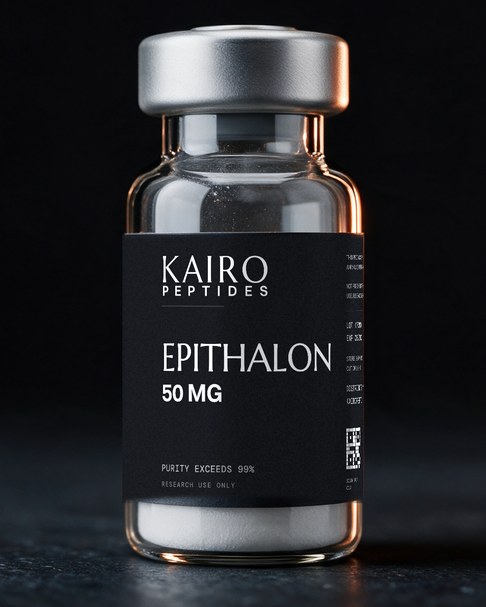
Epithalon
50MGStudied for telomere length, cellular aging, and lifespan in laboratory animals. Every paper behind those is linked below.
$79.00
- PURITY EXCEEDS 99%
- COA WITH EVERY BATCH
- 3RD-PARTY VERIFIED
| Title | Range | Discount |
|---|---|---|
| Pack tier: Epithalon (KAIRO-EPITHALON-50MG) | 1 - 2 | $79.00 |
| Pack of 3+: 10% off | 3 - 4 | $71.10 |
| Pack of 5+: 15% off | 5 - 9 | $67.15 |
| Pack of 10+: 20% off | 10 + | $63.20 |
For laboratory research use only. Not for human or veterinary use, not for diagnostic or therapeutic use, and not for food or drug manufacture. No preparation or usage guidance is provided anywhere on this page.
Longer telomeres. Longer-lived animals.
Both of those were measured in a laboratory, one in human cells in a dish and one in mice and flies, and no human study of this peptide was located.
-
Telomere length
Preclinical moderate A well-described result with several independent outcome measures, but from a single laboratory or a single study design.Epithalon is studied for telomere length in human cells grown in a laboratory dish, reported to lengthen telomeres and let aging cells divide 10 more times past the point they normally stop. A laboratory with no connection to the original group reported the lengthening again in 2025, across 4 human cell lines.
-
Aging and lifespan
Preclinical moderate A well-described result with several independent outcome measures, but from a single laboratory or a single study design.Epithalon is studied for lifespan in laboratory animals, reported across 2 mouse strains to raise the longest lifespans reached and to slow several age-related measures. The 2 studies disagree on whether the average mouse lived longer, and both come from the same research group.
Lifespan and aging-biomarker studies in mice Lifespan in fruit flies
-
Nerve-cell gene activity
Preclinical preliminary A single study, an early mechanistic observation, or a result whose interpretation is the authors' own inference.Epithalon is studied for gene activity in human stem cells taken from gum tissue, reported to modestly raise 4 genes associated with differentiation toward nerve cells, in the 1.6 to 1.8-fold range. This is a single laboratory dish study, and its own authors frame the mechanism as possible rather than confirmed.
Gene expression changes in human stem cells during neuron-like differentiation
Every line above describes what was measured in a laboratory. None of it establishes what the compound would do in a person.
Frequently paired with
What shoppers usually add alongside this one
A versatile peptide, studied in research on cell movement and tissue repair.
A recovery-focused blend, studied in research on tissue repair.
A multi-peptide skin blend, studied in research on skin and tissue.
What the research says about pairing these
Thymalin (a thymus-derived peptide preparation)
This is the single pairing in this literature with a genuine co-study basis, though not for the material this page sells: the human study cited above tested Thymalin and Epithalamin, the pineal extract, separately and together. It did not test Epithalon, the synthetic peptide. Epithalon with Thymalin is nonetheless a heavily marketed bundle among peptide vendors, found packaged together at multiple vendor sites reached in this pass.
No study of synthetic Epithalon together with Thymalin was located. The combination's marketing draws on a human result that was never run with the material being sold under the Epithalon name. The pairing is co-marketed, not jointly validated, and the co-study that does exist used a different substance.
NAD+ and GHK-Cu
Common further members of 'longevity stack' bundles sold alongside Epithalon and Thymalin at several vendor sites reached in this pass, marketed on a rationale of complementary mechanisms: telomere maintenance alongside mitochondrial and skin or collagen support. That rationale is assembled from separate literatures, not from any finding about the group.
No published study testing Epithalon together with either compound was identified. This is an observed market pattern only.
-
Studied for
Telomerase activity and telomere length in human cell lines
In telomerase-negative human fetal fibroblasts grown in culture, adding Epithalon was reported to induce expression of the telomerase catalytic subunit, measurable telomerase enzymatic activity, and telomere elongation; the authors read that as reactivation of the telomerase gene and proposed it could extend the lifespan of a cell population, a step beyond what the experiment itself measured. A follow-up from the same laboratory used primary lung fibroblasts from a 24-week fetus that stopped dividing at passage 34, the Hayflick limit for that culture, with shortened telomeres relative to early passage. Adding Epithalon to the aging culture was reported to restore telomere length to roughly the early-passage size and let the exposed cells complete 10 further divisions, to passage 44, while still dividing, against a control that stopped at passage 34. Both of those are single-laboratory, cell-culture findings with no organism-level lifespan measured. In 2025, a laboratory with no connection to the original group, at Brunel University London, independently tested Epithalon on 2 breast cancer cell lines (21NT, BT474) and 2 normal human cell lines (IBR.3 fibroblasts, HMEC mammary epithelial cells). It reported telomere lengthening and higher hTERT gene expression in all 4 lines, but by different routes: in the 2 cancer lines, telomerase enzyme activity itself did not rise significantly despite the higher hTERT message, and telomere lengthening tracked instead with a large rise in ALT activity, an alternative, telomerase-independent lengthening pathway associated with some cancers; in the 2 normal cell lines, telomerase enzyme activity itself rose substantially and ALT activity barely moved. The normal cells needed 3 weeks of exposure to show a significant telomere-length change, versus 4 days in the cancer lines. That paper is the first independent replication located of any part of the telomerase story, and it also complicates the original story by showing the effect runs through different mechanisms in normal versus cancerous cells. A formal correction was published 2 months after the original paper stating that the wrong versions of Figures 1, 2 and 3 had appeared; the correction replaces those figures but does not state in its own text whether any numeric value or direction of effect changed, so specific fold-change figures from that paper should be regarded as approximate pending independent confirmation against the corrected figures. None of this is organism-level lifespan data, and none of it was measured on Epithalamin, the extract. IN VITRO in vitro, human fetal-derived fibroblast cultures for the original 2003 to 2004 work; in vitro, 2 human breast cancer lines and 2 normal human cell lines for the independent 2025 replication Preclinical moderate A well-described result with several independent outcome measures, but from a single laboratory or a single study design. Open for the full finding and the paper it came from.In the literatureTelomerase activity and telomere length in human cell lines
In telomerase-negative human fetal fibroblasts grown in culture, adding Epithalon was reported to induce expression of the telomerase catalytic subunit, measurable telomerase enzymatic activity, and telomere elongation; the authors read that as reactivation of the telomerase gene and proposed it could extend the lifespan of a cell population, a step beyond what the experiment itself measured. A follow-up from the same laboratory used primary lung fibroblasts from a 24-week fetus that stopped dividing at passage 34, the Hayflick limit for that culture, with shortened telomeres relative to early passage. Adding Epithalon to the aging culture was reported to restore telomere length to roughly the early-passage size and let the exposed cells complete 10 further divisions, to passage 44, while still dividing, against a control that stopped at passage 34. Both of those are single-laboratory, cell-culture findings with no organism-level lifespan measured. In 2025, a laboratory with no connection to the original group, at Brunel University London, independently tested Epithalon on 2 breast cancer cell lines (21NT, BT474) and 2 normal human cell lines (IBR.3 fibroblasts, HMEC mammary epithelial cells). It reported telomere lengthening and higher hTERT gene expression in all 4 lines, but by different routes: in the 2 cancer lines, telomerase enzyme activity itself did not rise significantly despite the higher hTERT message, and telomere lengthening tracked instead with a large rise in ALT activity, an alternative, telomerase-independent lengthening pathway associated with some cancers; in the 2 normal cell lines, telomerase enzyme activity itself rose substantially and ALT activity barely moved. The normal cells needed 3 weeks of exposure to show a significant telomere-length change, versus 4 days in the cancer lines. That paper is the first independent replication located of any part of the telomerase story, and it also complicates the original story by showing the effect runs through different mechanisms in normal versus cancerous cells. A formal correction was published 2 months after the original paper stating that the wrong versions of Figures 1, 2 and 3 had appeared; the correction replaces those figures but does not state in its own text whether any numeric value or direction of effect changed, so specific fold-change figures from that paper should be regarded as approximate pending independent confirmation against the corrected figures. None of this is organism-level lifespan data, and none of it was measured on Epithalamin, the extract.References 1, 2, 3, 4
Modelin vitro, human fetal-derived fibroblast cultures for the original 2003 to 2004 work; in vitro, 2 human breast cancer lines and 2 normal human cell lines for the independent 2025 replication
-
Studied for
Lifespan and aging-biomarker studies in mice
2 related studies from the same core laboratory compared subcutaneous Epithalon with saline in female mice, from young adulthood until natural death, in 2 different strains, and got different results on the headline measure of mean lifespan. In outbred Swiss-derived SHR mice (54 mice per group, starting at 3 months of age, 5 consecutive days each month), Epithalon was reported to have no effect on food consumption, body weight, or mean lifespan. It was reported to slow the age-related decline of estrous cycling, reduce chromosome aberrations in bone marrow cells by 17.1%, increase the lifespan of the longest-lived 10% of animals by 13.3%, and increase maximum lifespan by 12.3%, all against the saline control. Total spontaneous tumor incidence was unchanged. In a separate strain, CBA mice (starting at 6 months of age, the same monthly schedule), Epithalon was reported to leave food consumption and physical strength unchanged while increasing body weight, increasing mean survival by 5.3%, increasing maximum lifespan by about 10 months, slowing the age-related decline of estrous cycling, and reducing body temperature, physical activity, measures of free-radical activity, and spontaneous tumor incidence. Read together rather than cherry-picked: the 2 studies agree that maximum lifespan and several aging-biomarker measures moved in a favorable direction, and disagree on mean lifespan, null in SHR mice and a reported 5.3% increase in CBA mice. That strain-to-strain inconsistency, on the single most important summary number, is stated here rather than smoothed over. Both studies share Khavinson as a senior author, and no lifespan study of Epithalon from a fully independent laboratory was located in this search pass. female mice, 2 separate strains (outbred Swiss-derived SHR and CBA), subcutaneous courses from young adulthood until natural death Preclinical moderate A well-described result with several independent outcome measures, but from a single laboratory or a single study design. Open for the full finding and the paper it came from.In the literatureLifespan and aging-biomarker studies in mice
2 related studies from the same core laboratory compared subcutaneous Epithalon with saline in female mice, from young adulthood until natural death, in 2 different strains, and got different results on the headline measure of mean lifespan. In outbred Swiss-derived SHR mice (54 mice per group, starting at 3 months of age, 5 consecutive days each month), Epithalon was reported to have no effect on food consumption, body weight, or mean lifespan. It was reported to slow the age-related decline of estrous cycling, reduce chromosome aberrations in bone marrow cells by 17.1%, increase the lifespan of the longest-lived 10% of animals by 13.3%, and increase maximum lifespan by 12.3%, all against the saline control. Total spontaneous tumor incidence was unchanged. In a separate strain, CBA mice (starting at 6 months of age, the same monthly schedule), Epithalon was reported to leave food consumption and physical strength unchanged while increasing body weight, increasing mean survival by 5.3%, increasing maximum lifespan by about 10 months, slowing the age-related decline of estrous cycling, and reducing body temperature, physical activity, measures of free-radical activity, and spontaneous tumor incidence. Read together rather than cherry-picked: the 2 studies agree that maximum lifespan and several aging-biomarker measures moved in a favorable direction, and disagree on mean lifespan, null in SHR mice and a reported 5.3% increase in CBA mice. That strain-to-strain inconsistency, on the single most important summary number, is stated here rather than smoothed over. Both studies share Khavinson as a senior author, and no lifespan study of Epithalon from a fully independent laboratory was located in this search pass.References 5, 6
Modelfemale mice, 2 separate strains (outbred Swiss-derived SHR and CBA), subcutaneous courses from young adulthood until natural death
-
Studied for
Tumor development in a transgenic mouse strain bred for early mammary tumors
In female FVB/N mice genetically engineered to carry the HER-2/neu oncogene, a strain bred to reliably develop spontaneous mammary tumors and used in this literature as a model of accelerated aging, monthly Epithalon courses from a young age were reported to reduce the cumulative number of tumors per mouse and the maximum tumor size reached, and to lower HER-2/neu messenger RNA expression in the tumors that did form by 3.7-fold, compared with saline control mice of the same strain. A restatement of the same dataset in a second journal gives the same 3.7-fold mRNA figure and states maximum tumor size as 33% lower than control. This is a single experiment in a single transgenic mouse strain, presented in 2 venues; it describes tumor development in that specific animal model and is not a claim about any disease in a person. female FVB/N HER-2/neu transgenic mice, a single experiment restated in 2 journals Preclinical moderate A well-described result with several independent outcome measures, but from a single laboratory or a single study design. Open for the full finding and the paper it came from.In the literatureTumor development in a transgenic mouse strain bred for early mammary tumors
In female FVB/N mice genetically engineered to carry the HER-2/neu oncogene, a strain bred to reliably develop spontaneous mammary tumors and used in this literature as a model of accelerated aging, monthly Epithalon courses from a young age were reported to reduce the cumulative number of tumors per mouse and the maximum tumor size reached, and to lower HER-2/neu messenger RNA expression in the tumors that did form by 3.7-fold, compared with saline control mice of the same strain. A restatement of the same dataset in a second journal gives the same 3.7-fold mRNA figure and states maximum tumor size as 33% lower than control. This is a single experiment in a single transgenic mouse strain, presented in 2 venues; it describes tumor development in that specific animal model and is not a claim about any disease in a person.References 7, 8
Modelfemale FVB/N HER-2/neu transgenic mice, a single experiment restated in 2 journals
-
Studied for
Lifespan in fruit flies
In wild-strain Drosophila melanogaster (Canton-S), Epithalon added to the culture medium only during the egg-to-larva developmental stage was reported to significantly increase the lifespan of the adult flies by 11 to 16%, at concentrations the paper describes as unprecedentedly low. The paper reports that the size of the lifespan increase did not depend on the concentration within the range tested, an unusual result worth stating plainly rather than smoothing into a typical concentration-response story. This is a single insect study from the compound's originating laboratory, with no independently replicated concentration-response relationship and no organism-level mechanism established connecting it to the telomerase work above. Drosophila melanogaster, wild-type Canton-S strain, developmental-stage-only exposure Preclinical preliminary A single study, an early mechanistic observation, or a result whose interpretation is the authors' own inference. Open for the full finding and the paper it came from.In the literatureLifespan in fruit flies
In wild-strain Drosophila melanogaster (Canton-S), Epithalon added to the culture medium only during the egg-to-larva developmental stage was reported to significantly increase the lifespan of the adult flies by 11 to 16%, at concentrations the paper describes as unprecedentedly low. The paper reports that the size of the lifespan increase did not depend on the concentration within the range tested, an unusual result worth stating plainly rather than smoothing into a typical concentration-response story. This is a single insect study from the compound's originating laboratory, with no independently replicated concentration-response relationship and no organism-level mechanism established connecting it to the telomerase work above.References 9
ModelDrosophila melanogaster, wild-type Canton-S strain, developmental-stage-only exposure
-
Studied for
Gene expression changes in human stem cells during neuron-like differentiation
In human gingival mesenchymal stem cells, a cell type taken from gum tissue and capable of differentiating along several lineages, adding the AEDG peptide (Epithalon) was reported to increase the expression of 4 markers associated with differentiation toward nerve cells, Nestin, GAP43, beta-Tubulin III and Doublecortin, with reported mRNA increases in the 1.6 to 1.8-fold range. The authors propose, as a hypothesis rather than a demonstrated mechanism, that short peptides including Epithalon may act by binding chromatin-associated proteins and influencing which genes a cell's machinery can reach, and they frame the paper's own title around a 'possible epigenetic mechanism' rather than a confirmed one. This is a single study, in cells outside the body, with modest fold-changes, and it does not show that a person's nerve cells, or any other tissue, respond the same way. IN VITRO in vitro, human gingival mesenchymal stem cells Preclinical preliminary A single study, an early mechanistic observation, or a result whose interpretation is the authors' own inference. Open for the full finding and the paper it came from.In the literatureGene expression changes in human stem cells during neuron-like differentiation
In human gingival mesenchymal stem cells, a cell type taken from gum tissue and capable of differentiating along several lineages, adding the AEDG peptide (Epithalon) was reported to increase the expression of 4 markers associated with differentiation toward nerve cells, Nestin, GAP43, beta-Tubulin III and Doublecortin, with reported mRNA increases in the 1.6 to 1.8-fold range. The authors propose, as a hypothesis rather than a demonstrated mechanism, that short peptides including Epithalon may act by binding chromatin-associated proteins and influencing which genes a cell's machinery can reach, and they frame the paper's own title around a 'possible epigenetic mechanism' rather than a confirmed one. This is a single study, in cells outside the body, with modest fold-changes, and it does not show that a person's nerve cells, or any other tissue, respond the same way.References 10
Modelin vitro, human gingival mesenchymal stem cells
-
Studied for
Human data on Epithalamin, a different pineal material, in elderly and coronary populations
Read the identity note first, because it governs everything in this entry: every human study located anywhere near this compound's name tested Epithalamin, the bovine pineal extract, not Epithalon, the synthetic tetrapeptide this page is about. Nothing here is evidence about Epithalon, and no effectiveness or safety conclusion carries across from either material to the other. The outcome figures these 2 papers report are also deliberately not restated on this page: they were measured on a different material, and restating human outcomes on a research-use commerce page would function as human benefit claims. What is reported here is the design. Khavinson and Morozov followed 266 elderly and older people for 6 to 8 years, giving a subset courses of Thymalin (a thymus-derived peptide preparation), Epithalamin, or both, during the first 2 to 3 years of that period, against an unspecified control group; the published abstract does not use the words randomized or blinded, and reports no confidence intervals or p-values for the ratios it gives. Separately, Korkushko and colleagues followed an elderly cardiac cohort for 15 years, with 39 people given 6 courses of Epithalamin over the first 3 years alongside standard cardiac care and 40 given standard care alone. That paper's own title describes it as a randomized comparative study, while the retrieved abstract text does not use the words blind or blinded anywhere and reports its mortality comparison only qualitatively, without a stated hazard ratio. The title also describes the preparation as coming from the pituitary gland while the abstract text attributes it to the pineal gland, an internal inconsistency in the source record that is reported here rather than silently resolved in either direction. The confidence rating on this entry describes the scale and duration of these 2 studies as human research designs, hundreds of subjects between them, multi-year, with 1 of the 2 labeled randomized. It does not describe the strength of evidence for Epithalon: because the material tested is Epithalamin, this entry supports no claim whatsoever about the synthetic peptide sold under the Epithalon name. in humans (266 elderly and older people, randomization and blinding not stated, for the pineal-and-thymus study; 39 given the extract versus 40 controls in an elderly cardiac cohort, described by that paper's own title as a randomized comparative study, with blinding not stated in the retrieved abstract text), both using Epithalamin, not Epithalon Preclinical moderate A well-described result with several independent outcome measures, but from a single laboratory or a single study design. Open for the full finding and the paper it came from.In the literatureHuman data on Epithalamin, a different pineal material, in elderly and coronary populations
Read the identity note first, because it governs everything in this entry: every human study located anywhere near this compound's name tested Epithalamin, the bovine pineal extract, not Epithalon, the synthetic tetrapeptide this page is about. Nothing here is evidence about Epithalon, and no effectiveness or safety conclusion carries across from either material to the other. The outcome figures these 2 papers report are also deliberately not restated on this page: they were measured on a different material, and restating human outcomes on a research-use commerce page would function as human benefit claims. What is reported here is the design. Khavinson and Morozov followed 266 elderly and older people for 6 to 8 years, giving a subset courses of Thymalin (a thymus-derived peptide preparation), Epithalamin, or both, during the first 2 to 3 years of that period, against an unspecified control group; the published abstract does not use the words randomized or blinded, and reports no confidence intervals or p-values for the ratios it gives. Separately, Korkushko and colleagues followed an elderly cardiac cohort for 15 years, with 39 people given 6 courses of Epithalamin over the first 3 years alongside standard cardiac care and 40 given standard care alone. That paper's own title describes it as a randomized comparative study, while the retrieved abstract text does not use the words blind or blinded anywhere and reports its mortality comparison only qualitatively, without a stated hazard ratio. The title also describes the preparation as coming from the pituitary gland while the abstract text attributes it to the pineal gland, an internal inconsistency in the source record that is reported here rather than silently resolved in either direction. The confidence rating on this entry describes the scale and duration of these 2 studies as human research designs, hundreds of subjects between them, multi-year, with 1 of the 2 labeled randomized. It does not describe the strength of evidence for Epithalon: because the material tested is Epithalamin, this entry supports no claim whatsoever about the synthetic peptide sold under the Epithalon name.References 11, 12
Modelin humans (266 elderly and older people, randomization and blinding not stated, for the pineal-and-thymus study; 39 given the extract versus 40 controls in an elderly cardiac cohort, described by that paper's own title as a randomized comparative study, with blinding not stated in the retrieved abstract text), both using Epithalamin, not Epithalon
-
Studied for
Lifespan across species with Epithalamin, the pineal extract, including in fruit flies
Read together with the identity note above: this entry is entirely about Epithalamin, the bovine pineal extract, not Epithalon. In a single 1998 paper, the same core research group reported that Epithalamin increased mean lifespan by 11 to 31% across female Drosophila melanogaster, SHR mice, C3H/Sn mice and LIO rats, and increased both the 90th-percentile survival point and maximum lifespan in fruit flies, C3H/Sn mice and rats. Mortality rate was reported reduced 52% in fruit flies, 52% in rats and 27% in C3H/Sn mice; SHR mice showed no mortality-rate change in this account, a genuine null result inside the same paper that should not be dropped from the summary. The authors proposed increased melatonin synthesis and secretion, plus inhibition of free-radical processes, as the likely mechanism. This is the extract's own foundational cross-species paper, from the laboratory that later built the synthetic Epithalon peptide as a simplified analogue of it, and it is offered here only as background for why the extract's reputation exists, not as evidence for the peptide sold under the Epithalon name. female Drosophila melanogaster, SHR mice, C3H/Sn mice and LIO rats, all given Epithalamin, the extract Preclinical preliminary A single study, an early mechanistic observation, or a result whose interpretation is the authors' own inference. Open for the full finding and the paper it came from.In the literatureLifespan across species with Epithalamin, the pineal extract, including in fruit flies
Read together with the identity note above: this entry is entirely about Epithalamin, the bovine pineal extract, not Epithalon. In a single 1998 paper, the same core research group reported that Epithalamin increased mean lifespan by 11 to 31% across female Drosophila melanogaster, SHR mice, C3H/Sn mice and LIO rats, and increased both the 90th-percentile survival point and maximum lifespan in fruit flies, C3H/Sn mice and rats. Mortality rate was reported reduced 52% in fruit flies, 52% in rats and 27% in C3H/Sn mice; SHR mice showed no mortality-rate change in this account, a genuine null result inside the same paper that should not be dropped from the summary. The authors proposed increased melatonin synthesis and secretion, plus inhibition of free-radical processes, as the likely mechanism. This is the extract's own foundational cross-species paper, from the laboratory that later built the synthetic Epithalon peptide as a simplified analogue of it, and it is offered here only as background for why the extract's reputation exists, not as evidence for the peptide sold under the Epithalon name.References 13
Modelfemale Drosophila melanogaster, SHR mice, C3H/Sn mice and LIO rats, all given Epithalamin, the extract
4 moderate / 3 preliminaryRated by how many independent labs and how many kinds of experiment found the same thing.
What is in the vial.
| Compound | Epithalon |
| Dosage form | Lyophilized powder |
| Purity | PURITY EXCEEDS 99% |
| Storage | STORE LYOPHILIZED. KEEP COLD AND OUT OF LIGHT. |
| Lot format | LOT + EXP printed per vial |
| Distribution | DISTRIBUTED BY KAIRO, KAIROPEPTIDES.COM |
A synthetic tetrapeptide.
The full technical write-up 3 paragraphs, plus the fact row
Epithalon, also spelled Epitalon and appearing in some of the literature as Epithalone, is a synthetic tetrapeptide with the sequence Ala-Glu-Asp-Gly (AEDG). It was developed at the St. Petersburg Institute of Bioregulation and Gerontology under Vladimir Kh. Khavinson as a defined, synthesized 4-amino-acid analogue of Epithalamin, an undefined polypeptide extract prepared from bovine pineal gland tissue. That identity point governs how everything below should be read: Epithalon is a single, chemically defined molecule, while Epithalamin is a mixture of several peptides pulled out of animal tissue, and the 2 names are not interchangeable even though they are etymologically related and are constantly confused in vendor and consumer material. Every finding below states which of the 2 materials was actually tested.
The confusion reaches the reference databases. Querying PubChem by the name 'Epitalon' returns CID 219042, and that record's synonym list, retrieved directly on this pass, carries 'Epitalon', 'Epithalon' and 'Epithalone' alongside 'Epithalamin' and 'Epithalamine' as though those names all belonged to a single substance; querying PubChem separately by the name 'Epithalamin' resolves to the same CID. That is stated here as an inconsistency in the database's synonym curation, not as confirmation that the peptide and the extract are the same material. A PubChem CID represents a single defined chemical structure, and an undefined multi-peptide tissue extract would not be expected to have a CID of its own, which is presumably why the curation folded its name onto the closest single-molecule entry. No PubChem record distinct from CID 219042 was located for Epithalamin.
The shape of the literature is a finding in its own right. A live PubMed search run on this pass returned 142 records for epitalon, epithalon or epithalone, of which 90, about 63%, list Khavinson as an author; a separate search for epithalamin or epithalamine returned 102 further records, indicating a comparably large and largely separate body of extract-specific work. Independent, non-Khavinson-group replication of the peptide's core claims is limited to a single 2025 paper, covered below. Epithalon itself has not been carried through a Phase 1, 2 or 3 clinical trial under standard human-trials regulatory frameworks, and the only human data located anywhere near this compound's name was run on Epithalamin, the extract, not on Epithalon. It is not an approved drug in the United States or anywhere else. Everything described below is what researchers observed in laboratory systems. None of it is a statement about effects in a person, and no preparation or usage guidance is given anywhere on this page.References 3, 14
- Length
- 4 amino acids (a tetrapeptide)
- Also known as
- Epitalon, Epithalone, AEDG peptide, alanyl-glutamyl-aspartyl-glycine
- Status
- Not an approved drug in the United States or anywhere else
Sold as a laboratory research material.
Molecular identity
Sequence, formula and registry numbers 4 residues
- A Ala
- E Glu
- D Asp
- G Gly
4 residues.
- Formula
- Registered form C14H22N4O9
- Molar mass
- Registered form 390.35 g/mol
- CAS
- Registered form 307297-39-8 and 64082-79-7(both appear in the same PubChem synonym list, with no field indicating which is preferred or what distinguishes them, so either may legitimately be encountered)
- PubChem CID
- Registered form 219042
The same PubChem record's synonym list also carries 'Epithalamin' and 'Epithalamine'. This page reads that as an inconsistency in the database's synonym curation and not as evidence that the extract and the peptide share a defined structure: Epithalamin is a multi-component tissue extract with no established single molecular formula of its own. The 2 CAS numbers above are reported together, unresolved, rather than this page silently preferring either one.References 14
Once it is mixed, it goes in the fridge.
Water is what ages a peptide, so the rules change the moment you add it.
The longer version 3 rows
- Before you mix it
- Supplied as a lyophilized (freeze-dried) powder. No peer-reviewed, compound-specific stability study establishing a validated shelf life for this peptide, dry or in solution, was located in this search pass, so what follows is general laboratory convention for short lyophilized peptides rather than a measured result for this material, and no supplier, brand or vendor datasheet is cited as an authority for any of it. That convention is to hold the sealed vial frozen for long-term storage, commonly at or below -4 F (-20 C), with about -112 F (-80 C) used for longer archival storage, kept dry and shielded from light and moisture, and to avoid repeated freeze-thaw cycles, which degrade peptide material. Brief room-temperature exposure in transit is generally tolerated by dry powder.
- Once it is mixed
- Once it is mixed, keep the vial refrigerated at 36 to 46 F (2 to 8 C), and hold it no longer than 28 days. The 28 days is the sterility limit USP <797> assigns to a preserved multiple-use vial, not a measured chemical stability window for this peptide, and it is never to be written as 'stable for 28 days'. Storage and handling is not usage guidance: mixing volumes, concentrations, routes and schedules are preparation-for-administration details, and they are withheld here as they are on every page in this catalog.
- In the literature
- None located. No peer-reviewed study of this peptide's own stability, dry or in solution, was found in this search pass, so this page states no compound-specific shelf life, in-use window or degradation route for it. The absence is reported rather than filled in with general peptide chemistry standing in for a result nobody published.
Every paper this page is built on.
Click any journal to open the paper.
The full list 14 references, each linked
-
1
Khavinson VKh, Bondarev IE, Butyugov AA. Epithalon peptide induces telomerase activity and telomere elongation in human somatic cells. Bull Exp Biol Med. 2003;135(6):590-592.
-
2
Khavinson VKh, Bondarev IE, Butyugov AA, Smirnova TD. Peptide promotes overcoming of the division limit in human somatic cell. Bull Exp Biol Med. 2004;137(5):503-506.
-
3
Al-Dulaimi S, Thomas R, Matta S, Roberts T. Epitalon increases telomere length in human cell lines through telomerase upregulation or ALT activity. Biogerontology. 2025;26(5):178.
PubMed 40908429 doi:10.1007/s10522-025-10315-x Free full text
-
4
Correction: Epitalon increases telomere length in human cell lines through telomerase upregulation or ALT activity. Biogerontology. 2025;27(1):1.
PubMed 41240216 doi:10.1007/s10522-025-10326-8 Free full text
-
5
Anisimov VN, Khavinson VKh, Popovich IG, Zabezhinski MA, Alimova IN, Rosenfeld SV, Zavarzina NY, Semenchenko AV, Yashin AI. Effect of Epitalon on biomarkers of aging, life span and spontaneous tumor incidence in female Swiss-derived SHR mice. Biogerontology. 2003;4(4):193-202.
-
6
Anisimov VN, Khavinson VKh, Mikhalski AI, Yashin AI. Effect of synthetic thymic and pineal peptides on biomarkers of ageing, survival and spontaneous tumour incidence in female CBA mice. Mech Ageing Dev. 2001;122(1):41-68.
-
7
Anisimov VN, Khavinson VKh, Provinciali M, Alimova IN, Baturin DA, Popovich IG, Zabezhinski MA, Imyanitov EN, Mancini R, Franceschi C. Inhibitory effect of the peptide epitalon on the development of spontaneous mammary tumors in HER-2/neu transgenic mice. Int J Cancer. 2002;101(1):7-10.
-
8
Anisimov VN, Khavinson VKh, Provinciali M, Mancini R, Franceschi C, et al. Epithalon inhibits tumor growth and expression of HER-2/neu oncogene in breast tumors in transgenic mice characterized by accelerated aging. Bull Exp Biol Med. 2002;133(2):167-170.
-
9
Khavinson VKh, Izmaylov DM, Obukhova LK, Malinin VV. Effect of epitalon on the lifespan increase in Drosophila melanogaster. Mech Ageing Dev. 2000;120(1-3):141-149.
-
10
Khavinson V, Diomede F, Mironova E, Linkova N, Trofimova S, Trubiani O, Caputi S, Sinjari B. AEDG Peptide (Epitalon) Stimulates Gene Expression and Protein Synthesis during Neurogenesis: Possible Epigenetic Mechanism. Molecules. 2020;25(3):609.
-
11
Khavinson VKh, Morozov VG. Peptides of pineal gland and thymus prolong human life. Neuro Endocrinol Lett. 2003;24(3-4):233-240. No DOI is present in the PubMed record and a Crossref title and author search returned no match on this pass, so this reference is carried by PMID only.
-
12
Korkushko OV, Khavinson VKh, Shatilo VB, Antonyk-Sheglova IA. Peptide geroprotector from the pituitary gland inhibits rapid aging of elderly people: results of 15-year follow-up. Bull Exp Biol Med. 2011;151(3):366-369.
-
13
Anisimov VN, Mylnikov SV, Khavinson VKh. Pineal peptide preparation epithalamin increases the lifespan of fruit flies, mice and rats. Mech Ageing Dev. 1998;103(2):123-132.
-
14
PubChem Compound Summary for CID 219042, Epitalon. National Center for Biotechnology Information. Retrieved July 28, 2026.
14 sources: 13 peer-reviewed papers and 1 primary documents.
Sources re-verified July 28, 2026
THIS PRODUCT IS NOT FOR HUMAN OR ANIMAL CONSUMPTION OF ANY KIND.
NOT FOR THERAPEUTIC OR DIAGNOSTIC USE. RESEARCH USE ONLY.
An investigational peptide, studied in research on metabolism.
A resilient peptide, studied in research on tissue repair and the gut lining.
A cellular coenzyme, studied in research on energy metabolism and cellular aging.