
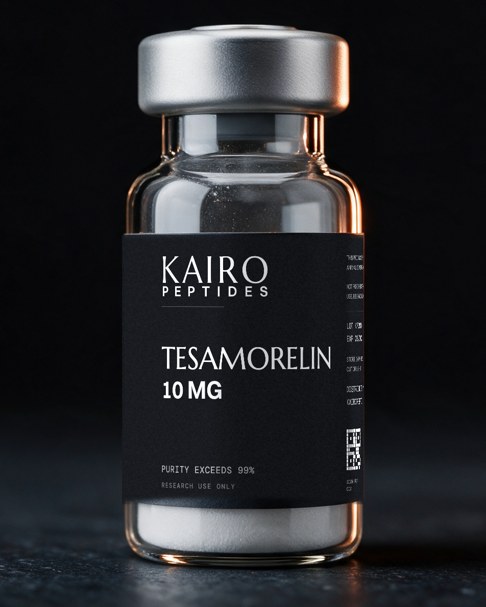
Tesamorelin
10MGStudied for the deep fat around the organs, liver fat, triglycerides and cholesterol ratios, lean body mass, and the body's own growth hormone. Every paper behind those is linked below.
$69.00
- PURITY EXCEEDS 99%
- COA WITH EVERY BATCH
- 3RD-PARTY VERIFIED
| Title | Range | Discount |
|---|---|---|
| Pack tier: Tesamorelin (KAIRO-TESAMORELIN-10MG) | 1 - 2 | $69.00 |
| Pack of 3+: 10% off | 3 - 4 | $62.10 |
| Pack of 5+: 15% off | 5 - 9 | $58.65 |
| Pack of 10+: 20% off | 10 + | $55.20 |
For laboratory research use only. Not for human or veterinary use, not for diagnostic or therapeutic use, and not for food or drug manufacture. No preparation or usage guidance is provided anywhere on this page.
One kind of fat moves. The other does not.
The fat packed deep around the organs moved in trial after trial, the fat under the skin did not, and the blood-fat and lean-mass numbers below follow from which fat left.
-
Visceral fat, the deep fat around the organs
Preclinical strong Convergent results from more than one randomized controlled trial in people, or a meta-analysis pooling them. The design is the highest available. The ceiling is the population: every controlled fat trial behind a 'strong' rating on this page ran in adults living with HIV who had excess abdominal fat, so 'strong' means strong inside that population and establishes nothing outside it.Tesamorelin has been studied against placebo for this one kind of fat in 5 randomized trials, and in the largest of them that fat fell 15.2 percent on a CT scan while it rose 5.0 percent on placebo.
All the randomized trials pooled together Pooled analysis of both phase 3 trials, including fat under the skin and 52-week durability Pivotal phase 3 trial of deep abdominal fat, in adults with HIV
-
The fat under the skin, unchanged
Preclinical strong Convergent results from more than one randomized controlled trial in people, or a meta-analysis pooling them. The design is the highest available. The ceiling is the population: every controlled fat trial behind a 'strong' rating on this page ran in adults living with HIV who had excess abdominal fat, so 'strong' means strong inside that population and establishes nothing outside it.Tesamorelin appears to move one kind of fat and leave the other alone, and pooled across 806 participants in 2 phase 3 trials the fat just under the skin did not significantly change. That is the opposite of what most marketing for this compound implies.
All the randomized trials pooled together Pooled analysis of both phase 3 trials, including fat under the skin and 52-week durability
-
What happens when it stops
Preclinical strong Convergent results from more than one randomized controlled trial in people, or a meta-analysis pooling them. The design is the highest available. The ceiling is the population: every controlled fat trial behind a 'strong' rating on this page ran in adults living with HIV who had excess abdominal fat, so 'strong' means strong inside that population and establishes nothing outside it.Tesamorelin is reported to hold that deep fat down only while exposure continues, and in 2 randomized trials the fat came back once exposure ended. The investigators concluded the effect does not last beyond the period of exposure.
What happens when exposure stops Second phase 3 trial with a blinded withdrawal arm
-
Triglycerides and cholesterol ratios
Preclinical strong Convergent results from more than one randomized controlled trial in people, or a meta-analysis pooling them. The design is the highest available. The ceiling is the population: every controlled fat trial behind a 'strong' rating on this page ran in adults living with HIV who had excess abdominal fat, so 'strong' means strong inside that population and establishes nothing outside it.Tesamorelin has been studied alongside blood-fat measures, and in a 26-week randomized trial triglycerides fell 50 mg/dL against a 9 mg/dL rise on placebo while the total-cholesterol-to-HDL ratio fell 0.31 against a 0.21 rise.
Pooled analysis of both phase 3 trials, including fat under the skin and 52-week durability Pivotal phase 3 trial of deep abdominal fat, in adults with HIV
-
Lean mass and body composition
Preclinical strong Convergent results from more than one randomized controlled trial in people, or a meta-analysis pooling them. The design is the highest available. The ceiling is the population: every controlled fat trial behind a 'strong' rating on this page ran in adults living with HIV who had excess abdominal fat, so 'strong' means strong inside that population and establishes nothing outside it.Tesamorelin has been examined for its effect on lean tissue, and a meta-analysis of 5 randomized trials reported lean body mass 1.42 kg higher than placebo. No trial in this record measured strength or performance, so neither is claimed here.
-
Liver fat
Preclinical moderate A well-described result from a single controlled study with several independent outcome measures, or a finding reported on the regulatory record for the approved drug product.Tesamorelin has been studied for the fat stored inside the liver, and in a 12-month randomized trial that fat fell further than on placebo, a 37 percent relative reduction. Liver fat only. The trial reported nothing about scarring.
Liver fat over 12 months, measured by magnetic resonance spectroscopy Liver fat measured alongside deep abdominal fat
-
Growth hormone and IGF-1
Preclinical moderate A well-described result from a single controlled study with several independent outcome measures, or a finding reported on the regulatory record for the approved drug product.Tesamorelin is described as pushing the pituitary to release the body's own growth hormone rather than replacing it. In 13 healthy men overnight growth hormone rose over 2 weeks, and in a 26-week randomized trial IGF-1 rose 81.0 percent against a 5.0 percent fall on placebo.
Pivotal phase 3 trial of deep abdominal fat, in adults with HIV What it does to the body's own growth hormone rhythm
Every line above describes what was measured in a laboratory. None of it establishes what the compound would do in a person.
Frequently paired with
What shoppers usually add alongside this one
A versatile peptide, studied in research on cell movement and tissue repair.
A recovery-focused blend, studied in research on tissue repair.
A multi-peptide skin blend, studied in research on skin and tissue.
What the research says about pairing these
GHRP-class growth hormone secretagogues (GHRP-2, GHRP-6, ipamorelin, hexarelin)
A genuine mechanistic pairing, but only at the class level. GHRH-receptor agonists and ghrelin-receptor agonists act through different pituitary pathways, which is the reason this pairing is offered at all. The caveat that decides both badges: that class-level work was done with GHRH and GHRH-type peptides, not with tesamorelin, and a combination would by design push growth hormone past the pulsatile pattern tesamorelin alone produces.
In 18 healthy men, submaximal amounts of a growth hormone releasing peptide given together with GHRH stimulated growth hormone release synergistically, and the authors concluded that the 2 act independently. In a separate study of 9 healthy men, a specific GHRH antagonist eliminated most of the growth hormone response to GHRP-6 (maximal increase over baseline 33.8 plus or minus 4.8 against 6.2 plus or minus 1.8 micrograms per liter, P<0.0001), showing that the body's own GHRH is necessary for most of that response in people. Neither study used tesamorelin. Within the search coverage described above, no published trial of tesamorelin with any compound in this class was located, which is why Co-studied reads false: the badge cannot be stronger than the pairing it labels.
CJC-1295 (with or without DAC)
Very commonly co-marketed with tesamorelin, and mechanistically redundant rather than complementary: both are GHRH-receptor agonists, so this is 2 agents pushing on the same receptor. Co-marketing lore, not literature.
Within the search coverage described above, no published human trial has tested this combination.
Ipamorelin with CJC-1295, promoted alongside tesamorelin as a 3-compound combination
The most widely promoted tesamorelin combination in this market. The class-level GHRH-plus-GHRP evidence in the first entry above is the only real scientific rationale anywhere near it, and that evidence was generated with GHRH and GHRH-type peptides rather than with these compounds.
Within the search coverage described above, no published clinical trial of the 3-peptide combination was located, and the ipamorelin plus CJC-1295 pair itself has no published human body-composition trial.
GLP-1 receptor agonists (semaglutide, tirzepatide)
Frequently co-marketed on the theory that a GLP-1 agonist drives overall fat reduction while tesamorelin acts on the deep visceral depot. Biologically plausible and an obvious research question. Speculative until somebody runs it.
Within the search coverage described above, no published randomized trial of the combination was located.
BPC-157 and TB-500
Bundled with tesamorelin in vendor recovery-themed assortments. There is no mechanistic link to GHRH signaling at all. Purely a commercial pairing.
Within the search coverage described above, no combination study of any kind was located.
AOD-9604
Co-marketed as a fat-reduction adjunct alongside tesamorelin. AOD-9604 is a fragment of growth hormone rather than a secretagogue, so the two are not doing the same kind of thing.
Within the search coverage described above, no study evaluating the 2 together was located.
Structured exercise, which is not a compound and is listed here only because it is the sole registered prospective combination protocol
Not a compound and not sold with anything, which is why both badges read false. It is carried in this section because it is the only place in the entire tesamorelin literature where a combination is being studied prospectively rather than asserted commercially, and a reader deserves to know that the one real combination protocol involves exercise rather than another peptide.
TRIUMPH (NCT06554717) is a 2-site, double-blind randomized trial of 100 sedentary older adults aged 50 to 80 living with HIV who are frail or at risk for frailty and have excess abdominal adiposity, randomized to tesamorelin or placebo alongside a home-based semisupervised exercise program for 24 weeks, followed by a 24-week extension phase of independent exercise, with endpoints including physical function, muscle content and quality, muscle fat and mitochondrial function. It was recruiting and had posted no results at the time of this verification pass, so nothing whatsoever can be claimed about its outcome and Co-studied reads false.
-
Studied for
All the randomized trials pooled together
A systematic review and random-effects meta-analysis searching PubMed, Embase, Scopus, Web of Science and CENTRAL through July 2025 identified 5 randomized controlled trials of tesamorelin against placebo in adults with HIV. Pooled results showed reductions in visceral fat (mean difference -27.71 cm2, 95% CI -38.37 to -17.06; P<0.001), trunk fat (-1.18 kg, 95% CI -1.40 to -0.96; P<0.001), limb fat (-0.22 kg, 95% CI -0.35 to -0.08; P=0.001), liver fat percentage (-4.28%, 95% CI -6.31 to -2.24; P<0.001) and waist circumference (-1.61 cm, 95% CI -2.28 to -0.95; P<0.001), and an increase in lean body mass (+1.42 kg, 95% CI 1.13 to 1.71; P<0.001). No significant reduction in the fat under the skin and no significant BMI change were found, and there was no significant change in CD4+ T-cell counts. Adverse events reported across the pooled trials include joint pain, muscle pain, pins and needles, and application-site reactions such as redness. The authors' own conclusion states the improvements occurred without serious side effects or perturbation of glucose; that is their summary of their pooled set, and this page does not adopt it as a safety statement of its own. meta-analysis of 5 human randomized controlled trials Preclinical strong Convergent results from more than one randomized controlled trial in people, or a meta-analysis pooling them. The design is the highest available. The ceiling is the population: every controlled fat trial behind a 'strong' rating on this page ran in adults living with HIV who had excess abdominal fat, so 'strong' means strong inside that population and establishes nothing outside it. Open for the full finding and the paper it came from.In the literatureAll the randomized trials pooled together
A systematic review and random-effects meta-analysis searching PubMed, Embase, Scopus, Web of Science and CENTRAL through July 2025 identified 5 randomized controlled trials of tesamorelin against placebo in adults with HIV. Pooled results showed reductions in visceral fat (mean difference -27.71 cm2, 95% CI -38.37 to -17.06; P<0.001), trunk fat (-1.18 kg, 95% CI -1.40 to -0.96; P<0.001), limb fat (-0.22 kg, 95% CI -0.35 to -0.08; P=0.001), liver fat percentage (-4.28%, 95% CI -6.31 to -2.24; P<0.001) and waist circumference (-1.61 cm, 95% CI -2.28 to -0.95; P<0.001), and an increase in lean body mass (+1.42 kg, 95% CI 1.13 to 1.71; P<0.001). No significant reduction in the fat under the skin and no significant BMI change were found, and there was no significant change in CD4+ T-cell counts. Adverse events reported across the pooled trials include joint pain, muscle pain, pins and needles, and application-site reactions such as redness. The authors' own conclusion states the improvements occurred without serious side effects or perturbation of glucose; that is their summary of their pooled set, and this page does not adopt it as a safety statement of its own.References 1
Modelmeta-analysis of 5 human randomized controlled trials
-
Studied for
Pooled analysis of both phase 3 trials, including fat under the skin and 52-week durability
Pooling 2 multicenter phase 3 trials that randomized 806 participants already receiving antiretroviral drugs 2:1 to tesamorelin (n=543) or placebo (n=263), deep visceral fat fell by 24 plus or minus 41 cm2 at week 26 against a rise of 2 plus or minus 35 cm2 on placebo (P<0.001; between-group effect -15.4%), while the fat just under the skin of the abdomen did not significantly change (-2 plus or minus 32 against 2 plus or minus 29 cm2, P=0.08; between-group effect -0.6%). Triglycerides fell 37 plus or minus 139 against a 6 plus or minus 112 mg/dL rise (P<0.001) and mean IGF-I rose 108 plus or minus 112 against -7 plus or minus 64 ng/mL (P<0.001). In the group that continued to week 52, the reductions in visceral fat (-35 plus or minus 50 cm2, or -17.5 plus or minus 23.3%) and waist circumference (-3.4 plus or minus 6.0 cm) held. The authors reported no clinically meaningful between-group differences in glucose parameters at weeks 26 and 52. The selectivity is the point here: the deep depot moved and the depot under the skin did not. pooled analysis of 2 human multicenter randomized double-blind placebo-controlled phase 3 trials (n=806, 26 weeks plus a 26-week extension) Preclinical strong Convergent results from more than one randomized controlled trial in people, or a meta-analysis pooling them. The design is the highest available. The ceiling is the population: every controlled fat trial behind a 'strong' rating on this page ran in adults living with HIV who had excess abdominal fat, so 'strong' means strong inside that population and establishes nothing outside it. Open for the full finding and the paper it came from.In the literaturePooled analysis of both phase 3 trials, including fat under the skin and 52-week durability
Pooling 2 multicenter phase 3 trials that randomized 806 participants already receiving antiretroviral drugs 2:1 to tesamorelin (n=543) or placebo (n=263), deep visceral fat fell by 24 plus or minus 41 cm2 at week 26 against a rise of 2 plus or minus 35 cm2 on placebo (P<0.001; between-group effect -15.4%), while the fat just under the skin of the abdomen did not significantly change (-2 plus or minus 32 against 2 plus or minus 29 cm2, P=0.08; between-group effect -0.6%). Triglycerides fell 37 plus or minus 139 against a 6 plus or minus 112 mg/dL rise (P<0.001) and mean IGF-I rose 108 plus or minus 112 against -7 plus or minus 64 ng/mL (P<0.001). In the group that continued to week 52, the reductions in visceral fat (-35 plus or minus 50 cm2, or -17.5 plus or minus 23.3%) and waist circumference (-3.4 plus or minus 6.0 cm) held. The authors reported no clinically meaningful between-group differences in glucose parameters at weeks 26 and 52. The selectivity is the point here: the deep depot moved and the depot under the skin did not.References 2
Modelpooled analysis of 2 human multicenter randomized double-blind placebo-controlled phase 3 trials (n=806, 26 weeks plus a 26-week extension)
-
Studied for
Pivotal phase 3 trial of deep abdominal fat, in adults with HIV
In a 26-week randomized, double-blind, placebo-controlled trial in 412 adults with HIV and abdominal fat accumulation, the deep fat around the organs, measured by CT scan, went down by 15.2% in the tesamorelin group and up by 5.0% in the placebo group. Triglycerides fell by 50 mg/dL against a rise of 9 mg/dL, the total-cholesterol-to-HDL ratio fell by 0.31 against a rise of 0.21, and IGF-I rose by 81.0% against a 5.0% fall (P<0.001 for all of these). The investigators reported no significant differences in blood-sugar measures, and reported that adverse events did not differ significantly between groups although more people in the tesamorelin group withdrew because of an adverse event. This is a research outcome in a single specific study population and is not a general body-composition claim. human randomized double-blind placebo-controlled trial (n=412, 26 weeks) Preclinical strong Convergent results from more than one randomized controlled trial in people, or a meta-analysis pooling them. The design is the highest available. The ceiling is the population: every controlled fat trial behind a 'strong' rating on this page ran in adults living with HIV who had excess abdominal fat, so 'strong' means strong inside that population and establishes nothing outside it. Open for the full finding and the paper it came from.In the literaturePivotal phase 3 trial of deep abdominal fat, in adults with HIV
In a 26-week randomized, double-blind, placebo-controlled trial in 412 adults with HIV and abdominal fat accumulation, the deep fat around the organs, measured by CT scan, went down by 15.2% in the tesamorelin group and up by 5.0% in the placebo group. Triglycerides fell by 50 mg/dL against a rise of 9 mg/dL, the total-cholesterol-to-HDL ratio fell by 0.31 against a rise of 0.21, and IGF-I rose by 81.0% against a 5.0% fall (P<0.001 for all of these). The investigators reported no significant differences in blood-sugar measures, and reported that adverse events did not differ significantly between groups although more people in the tesamorelin group withdrew because of an adverse event. This is a research outcome in a single specific study population and is not a general body-composition claim.References 3
Modelhuman randomized double-blind placebo-controlled trial (n=412, 26 weeks)
-
Studied for
What happens when exposure stops
In a 26-week extension of a phase 3 trial, 410 participants had been randomized to tesamorelin (n=273) or placebo (n=137) for the first 26 weeks. At week 26 the people originally on tesamorelin were re-randomized to continue or to switch to placebo, while the people originally on placebo were switched onto tesamorelin. Among those who kept taking it, the reduction in visceral fat held at -18% across 52 weeks (P<0.001 against baseline), as did the triglyceride change (-51 mg/dL, P<0.001 against baseline). The authors reported that upon discontinuation, visceral fat reaccumulated, and concluded that the effects on visceral fat do not last beyond the period of exposure. Changes in glucose parameters over 52 weeks were described as not clinically significant. human randomized double-blind trial with a 26-week extension (n=410 randomized, 52 weeks total) Preclinical strong Convergent results from more than one randomized controlled trial in people, or a meta-analysis pooling them. The design is the highest available. The ceiling is the population: every controlled fat trial behind a 'strong' rating on this page ran in adults living with HIV who had excess abdominal fat, so 'strong' means strong inside that population and establishes nothing outside it. Open for the full finding and the paper it came from.In the literatureWhat happens when exposure stops
In a 26-week extension of a phase 3 trial, 410 participants had been randomized to tesamorelin (n=273) or placebo (n=137) for the first 26 weeks. At week 26 the people originally on tesamorelin were re-randomized to continue or to switch to placebo, while the people originally on placebo were switched onto tesamorelin. Among those who kept taking it, the reduction in visceral fat held at -18% across 52 weeks (P<0.001 against baseline), as did the triglyceride change (-51 mg/dL, P<0.001 against baseline). The authors reported that upon discontinuation, visceral fat reaccumulated, and concluded that the effects on visceral fat do not last beyond the period of exposure. Changes in glucose parameters over 52 weeks were described as not clinically significant.References 4
Modelhuman randomized double-blind trial with a 26-week extension (n=410 randomized, 52 weeks total)
-
Studied for
Second phase 3 trial with a blinded withdrawal arm
In a 12-month, two-phase study of 404 adults with HIV and excess abdominal fat, deep visceral fat fell 10.9% (21 cm2) on tesamorelin against 0.6% (1 cm2) on placebo during the 6-month efficacy phase (P<0.0001), with improvements in trunk fat (P<0.001), waist circumference (P=0.02) and waist-to-hip ratio (P=0.001), and no change in limb fat or in the abdominal fat just under the skin. IGF-1 rose (P<0.001) but no change in glucose parameters was seen. Visceral fat was reduced by approximately 18% (P<0.001) in the participants who continued for 12 months, and the investigators reported that the initial 6-month improvements were rapidly lost in those switched from tesamorelin to placebo. human randomized double-blind placebo-controlled trial with blinded re-randomization (n=404, 12 months) Preclinical strong Convergent results from more than one randomized controlled trial in people, or a meta-analysis pooling them. The design is the highest available. The ceiling is the population: every controlled fat trial behind a 'strong' rating on this page ran in adults living with HIV who had excess abdominal fat, so 'strong' means strong inside that population and establishes nothing outside it. Open for the full finding and the paper it came from.In the literatureSecond phase 3 trial with a blinded withdrawal arm
In a 12-month, two-phase study of 404 adults with HIV and excess abdominal fat, deep visceral fat fell 10.9% (21 cm2) on tesamorelin against 0.6% (1 cm2) on placebo during the 6-month efficacy phase (P<0.0001), with improvements in trunk fat (P<0.001), waist circumference (P=0.02) and waist-to-hip ratio (P=0.001), and no change in limb fat or in the abdominal fat just under the skin. IGF-1 rose (P<0.001) but no change in glucose parameters was seen. Visceral fat was reduced by approximately 18% (P<0.001) in the participants who continued for 12 months, and the investigators reported that the initial 6-month improvements were rapidly lost in those switched from tesamorelin to placebo.References 5
Modelhuman randomized double-blind placebo-controlled trial with blinded re-randomization (n=404, 12 months)
-
Studied for
Inflammation and clotting markers in the blood
In 410 adults with HIV and abdominal adiposity randomized to tesamorelin (n=273) or placebo (n=137) for 26 weeks, exposure produced a significant decrease from baseline in tissue plasminogen activator antigen (-2.2 plus or minus 2.5 against -1.6 plus or minus 2.9 ng/mL, P<0.05), while changes in plasminogen activator inhibitor-1 antigen were NOT significant against placebo. Among the participants receiving tesamorelin, changes in these markers were associated with the change in visceral fat (PAI-1 antigen rho=0.16, P=0.02; tPA antigen rho=0.16, P=0.02; adiponectin rho=-0.27, P<0.001), and those associations held after controlling for the IGF-1 change. The authors describe the effect as modest and call for further studies to determine clinical significance. These are biomarker observations, not demonstrated clinical anti-inflammatory outcomes. human randomized placebo-controlled trial, biomarker analysis (n=410, 26 weeks) Preclinical moderate A well-described result from a single controlled study with several independent outcome measures, or a finding reported on the regulatory record for the approved drug product. Open for the full finding and the paper it came from.In the literatureInflammation and clotting markers in the blood
In 410 adults with HIV and abdominal adiposity randomized to tesamorelin (n=273) or placebo (n=137) for 26 weeks, exposure produced a significant decrease from baseline in tissue plasminogen activator antigen (-2.2 plus or minus 2.5 against -1.6 plus or minus 2.9 ng/mL, P<0.05), while changes in plasminogen activator inhibitor-1 antigen were NOT significant against placebo. Among the participants receiving tesamorelin, changes in these markers were associated with the change in visceral fat (PAI-1 antigen rho=0.16, P=0.02; tPA antigen rho=0.16, P=0.02; adiponectin rho=-0.27, P<0.001), and those associations held after controlling for the IGF-1 change. The authors describe the effect as modest and call for further studies to determine clinical significance. These are biomarker observations, not demonstrated clinical anti-inflammatory outcomes.References 6
Modelhuman randomized placebo-controlled trial, biomarker analysis (n=410, 26 weeks)
-
Studied for
Cognition in older adults, with and without mild cognitive impairment
In a 20-week randomized, double-blind, placebo-controlled trial, 152 adults aged 55 to 87 (66 of them with mild cognitive impairment) took daily subcutaneous tesamorelin or placebo themselves. The analysis of all randomized participants indicated a favorable effect on cognition (P=.03), comparable in the adults with mild cognitive impairment and in the healthy older adults, and the analysis restricted to completers showed the same pattern (P=.002). Follow-on analyses indicated a positive effect on executive function (P=.005), assessed with Stroop Color-Word Interference, Task Switching, the Self-Ordered Pointing Test and Word Fluency, and a non-significant trend in verbal memory (P=.08). IGF-1 rose by 117% (P<.001), staying within the physiological range, and percent body fat fell 7.4% (P<.001). The metabolic signal that cuts the other way is kept here: fasting insulin rose within the normal range by 35% in the adults with mild cognitive impairment (P<.001) but not in the healthy adults. Adverse events were mild and were reported by 68% of the adults receiving tesamorelin against 36% on placebo. This is a single trial in a research setting, it has not been replicated at scale, and it supports no cognitive-benefit claim. human randomized double-blind placebo-controlled trial (n=152 randomized, 137 completed, 20 weeks) Preclinical moderate A well-described result from a single controlled study with several independent outcome measures, or a finding reported on the regulatory record for the approved drug product. Open for the full finding and the paper it came from.In the literatureCognition in older adults, with and without mild cognitive impairment
In a 20-week randomized, double-blind, placebo-controlled trial, 152 adults aged 55 to 87 (66 of them with mild cognitive impairment) took daily subcutaneous tesamorelin or placebo themselves. The analysis of all randomized participants indicated a favorable effect on cognition (P=.03), comparable in the adults with mild cognitive impairment and in the healthy older adults, and the analysis restricted to completers showed the same pattern (P=.002). Follow-on analyses indicated a positive effect on executive function (P=.005), assessed with Stroop Color-Word Interference, Task Switching, the Self-Ordered Pointing Test and Word Fluency, and a non-significant trend in verbal memory (P=.08). IGF-1 rose by 117% (P<.001), staying within the physiological range, and percent body fat fell 7.4% (P<.001). The metabolic signal that cuts the other way is kept here: fasting insulin rose within the normal range by 35% in the adults with mild cognitive impairment (P<.001) but not in the healthy adults. Adverse events were mild and were reported by 68% of the adults receiving tesamorelin against 36% on placebo. This is a single trial in a research setting, it has not been replicated at scale, and it supports no cognitive-benefit claim.References 7
Modelhuman randomized double-blind placebo-controlled trial (n=152 randomized, 137 completed, 20 weeks)
-
Studied for
A second randomized cognition trial that did not confirm the signal
A 6-month phase 2 randomized open-label trial compared daily subcutaneous tesamorelin against standard of care for neurocognitive impairment in 73 virally suppressed people with HIV and abdominal obesity, randomized 3:2. The tesamorelin group showed a trend toward improved neurocognitive performance at 6 months (mean change 0.146; 95% CI -0.002 to 0.294; P=.060) while the standard-of-care group did not (0.103; 95% CI -0.095 to 0.301; P=.295), but the difference between the groups was not significant (P=.673). IGF-1 rose, but the changes did not correlate with the summary change score or with waist circumference. Waist circumference fell more in the tesamorelin group (median difference -2.7 cm; P=.015). The authors noted insufficient power and the absence of a placebo arm and concluded that the study suggests no clear benefit. This null result is carried deliberately, as the counterweight to the single positive cognition trial above. human phase 2 randomized open-label trial against standard of care (n=73, 6 months) Preclinical moderate A well-described result from a single controlled study with several independent outcome measures, or a finding reported on the regulatory record for the approved drug product. Open for the full finding and the paper it came from.In the literatureA second randomized cognition trial that did not confirm the signal
A 6-month phase 2 randomized open-label trial compared daily subcutaneous tesamorelin against standard of care for neurocognitive impairment in 73 virally suppressed people with HIV and abdominal obesity, randomized 3:2. The tesamorelin group showed a trend toward improved neurocognitive performance at 6 months (mean change 0.146; 95% CI -0.002 to 0.294; P=.060) while the standard-of-care group did not (0.103; 95% CI -0.095 to 0.301; P=.295), but the difference between the groups was not significant (P=.673). IGF-1 rose, but the changes did not correlate with the summary change score or with waist circumference. Waist circumference fell more in the tesamorelin group (median difference -2.7 cm; P=.015). The authors noted insufficient power and the absence of a placebo arm and concluded that the study suggests no clear benefit. This null result is carried deliberately, as the counterweight to the single positive cognition trial above.References 8
Modelhuman phase 2 randomized open-label trial against standard of care (n=73, 6 months)
-
Studied for
Liver fat over 12 months, measured by magnetic resonance spectroscopy
In a 12-month randomized, double-blind, multicenter trial, 61 people with HIV whose livers were at least 5% fat by magnetic resonance spectroscopy were assigned 1:1 to tesamorelin or an identical placebo. Liver fat fell further on tesamorelin, with an absolute effect size of -4.1% (95% CI -7.6 to -0.7; p=0.018), a -37% relative reduction from baseline (95% CI -67 to -7; p=0.016). After 12 months, 35% of the tesamorelin group against 4% of the placebo group had a liver fat fraction below 5%, the threshold used to define the condition (p=0.0069). Changes in fasting glucose and glycated hemoglobin were not different between groups at 12 months. People receiving tesamorelin reported more localized application-site complaints, none judged serious. The authors framed their conclusion as tesamorelin 'might be beneficial' and called for further study of long-term effects on liver tissue. Note the scope deliberately: this entry reports liver fat only. The abstract of this trial reports no fibrosis endpoint of any kind, and the fibrosis language that circulates around this trial traces to the introductions of the authors' own later papers rather than to this trial's reported endpoints. human randomized double-blind placebo-controlled multicenter trial (n=61, 12 months, followed by a 6-month open-label phase) Preclinical moderate A well-described result from a single controlled study with several independent outcome measures, or a finding reported on the regulatory record for the approved drug product. Open for the full finding and the paper it came from.In the literatureLiver fat over 12 months, measured by magnetic resonance spectroscopy
In a 12-month randomized, double-blind, multicenter trial, 61 people with HIV whose livers were at least 5% fat by magnetic resonance spectroscopy were assigned 1:1 to tesamorelin or an identical placebo. Liver fat fell further on tesamorelin, with an absolute effect size of -4.1% (95% CI -7.6 to -0.7; p=0.018), a -37% relative reduction from baseline (95% CI -67 to -7; p=0.016). After 12 months, 35% of the tesamorelin group against 4% of the placebo group had a liver fat fraction below 5%, the threshold used to define the condition (p=0.0069). Changes in fasting glucose and glycated hemoglobin were not different between groups at 12 months. People receiving tesamorelin reported more localized application-site complaints, none judged serious. The authors framed their conclusion as tesamorelin 'might be beneficial' and called for further study of long-term effects on liver tissue. Note the scope deliberately: this entry reports liver fat only. The abstract of this trial reports no fibrosis endpoint of any kind, and the fibrosis language that circulates around this trial traces to the introductions of the authors' own later papers rather than to this trial's reported endpoints.References 9
Modelhuman randomized double-blind placebo-controlled multicenter trial (n=61, 12 months, followed by a 6-month open-label phase)
-
Studied for
Blood sugar, measured over 12 weeks in adults who already have type 2 diabetes
A 12-week randomized, placebo-controlled study of 53 adults with type 2 diabetes used 3 groups: placebo and 2 active arms at different exposure levels. The main outcome was the relative insulin response after drinking glucose. No significant differences were found between groups in that response over the 12 weeks, and at week 12 fasting glucose, HbA1c and overall glycemic control were not significantly different between groups. Relevant changes to diabetes medication were similar between groups and no participant left the study because of loss of glycemic control. Total cholesterol (-0.3 plus or minus 0.6 mmol/L) and non-HDL cholesterol (-0.3 plus or minus 0.5 mmol/L) fell significantly from baseline to week 12 in the higher-exposure arm (p<0.05 against placebo). This is small and short. The authors frame it as evidence that exposure did not alter insulin response or glycemic control over 12 weeks, not as proof of long-term metabolic neutrality, and neutrality is not an improvement. human randomized placebo-controlled three-arm study in type 2 diabetes (n=53, 12 weeks) Preclinical moderate A well-described result from a single controlled study with several independent outcome measures, or a finding reported on the regulatory record for the approved drug product. Open for the full finding and the paper it came from.In the literatureBlood sugar, measured over 12 weeks in adults who already have type 2 diabetes
A 12-week randomized, placebo-controlled study of 53 adults with type 2 diabetes used 3 groups: placebo and 2 active arms at different exposure levels. The main outcome was the relative insulin response after drinking glucose. No significant differences were found between groups in that response over the 12 weeks, and at week 12 fasting glucose, HbA1c and overall glycemic control were not significantly different between groups. Relevant changes to diabetes medication were similar between groups and no participant left the study because of loss of glycemic control. Total cholesterol (-0.3 plus or minus 0.6 mmol/L) and non-HDL cholesterol (-0.3 plus or minus 0.5 mmol/L) fell significantly from baseline to week 12 in the higher-exposure arm (p<0.05 against placebo). This is small and short. The authors frame it as evidence that exposure did not alter insulin response or glycemic control over 12 weeks, not as proof of long-term metabolic neutrality, and neutrality is not an improvement.References 10
Modelhuman randomized placebo-controlled three-arm study in type 2 diabetes (n=53, 12 weeks)
-
Studied for
Liver fat measured alongside deep abdominal fat
In a 6-month double-blind randomized placebo-controlled trial of 50 adults with HIV and abdominal fat accumulation (48 of whom received study drug), deep visceral fat fell with a between-group effect of -42 cm2 (95% CI -71 to -14; P=.005) and liver fat measured by magnetic resonance spectroscopy went down (median change in lipid-to-water percentage -2.0% on tesamorelin against 0.9% on placebo, P=.003; net between-group effect -2.9%). The fat under the skin did not significantly change (between-group effect -6 cm2, 95% CI -19 to 7, P=0.29), and fat inside muscle cells did not change. The unfavorable signals are kept here: fasting glucose rose in the tesamorelin group at 2 weeks (between-group effect 7 mg/dL, 95% CI 1 to 14, P=.03) though changes at 6 months were not significant (P=.72 across time points), and HbA1c showed a small but statistically significant increase from baseline to 6 months (0.20% against 0.02%, between-group effect 0.19%, 95% CI 0.01 to 0.36, P=0.03). The authors themselves called this a preliminary study. human randomized double-blind placebo-controlled trial (n=50 randomized, 48 received study drug, 6 months) Preclinical moderate A well-described result from a single controlled study with several independent outcome measures, or a finding reported on the regulatory record for the approved drug product. Open for the full finding and the paper it came from.In the literatureLiver fat measured alongside deep abdominal fat
In a 6-month double-blind randomized placebo-controlled trial of 50 adults with HIV and abdominal fat accumulation (48 of whom received study drug), deep visceral fat fell with a between-group effect of -42 cm2 (95% CI -71 to -14; P=.005) and liver fat measured by magnetic resonance spectroscopy went down (median change in lipid-to-water percentage -2.0% on tesamorelin against 0.9% on placebo, P=.003; net between-group effect -2.9%). The fat under the skin did not significantly change (between-group effect -6 cm2, 95% CI -19 to 7, P=0.29), and fat inside muscle cells did not change. The unfavorable signals are kept here: fasting glucose rose in the tesamorelin group at 2 weeks (between-group effect 7 mg/dL, 95% CI 1 to 14, P=.03) though changes at 6 months were not significant (P=.72 across time points), and HbA1c showed a small but statistically significant increase from baseline to 6 months (0.20% against 0.02%, between-group effect 0.19%, 95% CI 0.01 to 0.36, P=0.03). The authors themselves called this a preliminary study.References 11
Modelhuman randomized double-blind placebo-controlled trial (n=50 randomized, 48 received study drug, 6 months)
-
Studied for
How fast it moves through the body
A population pharmacokinetic analysis of 38 adults, some with HIV and some healthy, receiving daily subcutaneous tesamorelin for 14 consecutive days was best described by a one-compartment model with first-order and zero-order absorption and first-order elimination. Plasma clearance was estimated at 1,060 L/h (33.6% variation between individuals) and volume of distribution at 200 L (17.7%). Age, body size measures, race and health status were not related to the pharmacokinetic parameters within the ranges studied. The fraction absorbed by a first-order process was 13.1% higher on day 14 than on day 1. Note that this population model reports volume of distribution in liters while the approved labeling reports it in liters per kilogram; they are different quantities and should not be compared directly. human population pharmacokinetic modelling study (n=38 healthy adults and adults with HIV, 14 days) Preclinical moderate A well-described result from a single controlled study with several independent outcome measures, or a finding reported on the regulatory record for the approved drug product. Open for the full finding and the paper it came from.In the literatureHow fast it moves through the body
A population pharmacokinetic analysis of 38 adults, some with HIV and some healthy, receiving daily subcutaneous tesamorelin for 14 consecutive days was best described by a one-compartment model with first-order and zero-order absorption and first-order elimination. Plasma clearance was estimated at 1,060 L/h (33.6% variation between individuals) and volume of distribution at 200 L (17.7%). Age, body size measures, race and health status were not related to the pharmacokinetic parameters within the ranges studied. The fraction absorbed by a first-order process was 13.1% higher on day 14 than on day 1. Note that this population model reports volume of distribution in liters while the approved labeling reports it in liters per kilogram; they are different quantities and should not be compared directly.References 12
Modelhuman population pharmacokinetic modelling study (n=38 healthy adults and adults with HIV, 14 days)
-
Studied for
What it does to the body's own growth hormone rhythm
13 healthy men (mean age 45 years, mean BMI 27.3) received daily subcutaneous tesamorelin for 2 weeks, with overnight frequent blood sampling at baseline, after the 2 weeks, and after 2 weeks off it. The pre-specified primary endpoint was the change in mean overnight growth hormone, which rose (+0.5 plus or minus 0.1 micrograms per liter, P=0.004), as did average log10 growth hormone peak area (P=0.001) and basal growth hormone secretion (P=0.008). The authors concluded that it augments basal and pulsatile GH secretion. Among the secondary endpoints, IGF-I rose by 181 plus or minus 22 micrograms per liter (P<0.0001), while neither fasting glucose (P=0.93) nor insulin-stimulated glucose uptake measured by clamp (P=0.61) was significantly affected. human mechanistic study in healthy male volunteers (n=13, 2 weeks of exposure plus 2 weeks of withdrawal) Preclinical moderate A well-described result from a single controlled study with several independent outcome measures, or a finding reported on the regulatory record for the approved drug product. Open for the full finding and the paper it came from.In the literatureWhat it does to the body's own growth hormone rhythm
13 healthy men (mean age 45 years, mean BMI 27.3) received daily subcutaneous tesamorelin for 2 weeks, with overnight frequent blood sampling at baseline, after the 2 weeks, and after 2 weeks off it. The pre-specified primary endpoint was the change in mean overnight growth hormone, which rose (+0.5 plus or minus 0.1 micrograms per liter, P=0.004), as did average log10 growth hormone peak area (P=0.001) and basal growth hormone secretion (P=0.008). The authors concluded that it augments basal and pulsatile GH secretion. Among the secondary endpoints, IGF-I rose by 181 plus or minus 22 micrograms per liter (P<0.0001), while neither fasting glucose (P=0.93) nor insulin-stimulated glucose uptake measured by clamp (P=0.61) was significantly affected.References 13
Modelhuman mechanistic study in healthy male volunteers (n=13, 2 weeks of exposure plus 2 weeks of withdrawal)
-
Studied for
Antibodies formed against it in the trial population
The current FDA-approved prescribing information reports that in the clinical trials of the original formulation, anti-tesamorelin IgG antibodies were detected in 50% of the people who received it for 26 weeks and 47% of those who received it for 52 weeks. In the subset who had hypersensitivity reactions, anti-tesamorelin IgG antibodies were detected in 85%. Cross-reactivity to the body's own growth hormone-releasing hormone was observed in approximately 60% of those who developed anti-tesamorelin antibodies. The label also states that people with and without these antibodies had similar mean reductions in visceral fat and a similar IGF-1 response. This is an observed immunological finding in a drug-product trial population. human, pooled immunogenicity assessment across the clinical trial program, as reported in FDA prescribing information Preclinical moderate A well-described result from a single controlled study with several independent outcome measures, or a finding reported on the regulatory record for the approved drug product. Open for the full finding and the paper it came from.In the literatureAntibodies formed against it in the trial population
The current FDA-approved prescribing information reports that in the clinical trials of the original formulation, anti-tesamorelin IgG antibodies were detected in 50% of the people who received it for 26 weeks and 47% of those who received it for 52 weeks. In the subset who had hypersensitivity reactions, anti-tesamorelin IgG antibodies were detected in 85%. Cross-reactivity to the body's own growth hormone-releasing hormone was observed in approximately 60% of those who developed anti-tesamorelin antibodies. The label also states that people with and without these antibodies had similar mean reductions in visceral fat and a similar IGF-1 response. This is an observed immunological finding in a drug-product trial population.References 14
Modelhuman, pooled immunogenicity assessment across the clinical trial program, as reported in FDA prescribing information
-
Studied for
Liver-injury record
The NIH LiverTox monograph states that in clinical trials in adults with HIV-associated lipodystrophy, tesamorelin use was not associated with de novo elevations in serum enzymes and, in the monograph's own hedged wording, 'in some studies, was associated with decreases in preexisting ALT elevations'. It further states that instances of clinically apparent liver injury attributable to tesamorelin use have not been reported, and assigns likelihood score E, meaning an unlikely cause of clinically apparent liver injury. Absence of a recorded harm signal is not a protective effect, and nothing here should be read as one. human, curated systematic literature review (NIH NIDDK LiverTox monograph) Preclinical moderate A well-described result from a single controlled study with several independent outcome measures, or a finding reported on the regulatory record for the approved drug product. Open for the full finding and the paper it came from.In the literatureLiver-injury record
The NIH LiverTox monograph states that in clinical trials in adults with HIV-associated lipodystrophy, tesamorelin use was not associated with de novo elevations in serum enzymes and, in the monograph's own hedged wording, 'in some studies, was associated with decreases in preexisting ALT elevations'. It further states that instances of clinically apparent liver injury attributable to tesamorelin use have not been reported, and assigns likelihood score E, meaning an unlikely cause of clinically apparent liver injury. Absence of a recorded harm signal is not a protective effect, and nothing here should be read as one.References 15
Modelhuman, curated systematic literature review (NIH NIDDK LiverTox monograph)
-
Studied for
Animal toxicology on the regulatory record
Per the current FDA-approved prescribing information: giving tesamorelin acetate to rats during organogenesis and lactation produced hydrocephaly, fluid on the brain, in the offspring at approximately 2 and 4 times the clinical exposure respectively, based on measured drug exposure. During organogenesis, lower exposures of approximately 0.1 to 1 times the clinical exposure caused delayed skull bone formation in rats. No adverse developmental effects occurred in rabbits at up to approximately 500 times the clinical exposure. No potential for genetic damage was revealed in a battery of tests including gene mutations in bacteria (the Ames test), gene mutations in cultured hamster cells, and chromosomal damage in bone marrow cells in mice. There was no effect on fertility in male or female rats at exposures approximately equal to the clinical exposure. Lifetime cancer studies in rodents have not been conducted. This is regulatory toxicology on the record for the finished drug product, reported as such. It is not a statement about people, and the animal exposure amounts the label also prints are deliberately not reproduced here. IN VITRO rat, mouse and rabbit in vivo studies plus in vitro bacterial and mammalian-cell genotoxicity assays, as reported in FDA prescribing information Preclinical moderate A well-described result from a single controlled study with several independent outcome measures, or a finding reported on the regulatory record for the approved drug product. Open for the full finding and the paper it came from.In the literatureAnimal toxicology on the regulatory record
Per the current FDA-approved prescribing information: giving tesamorelin acetate to rats during organogenesis and lactation produced hydrocephaly, fluid on the brain, in the offspring at approximately 2 and 4 times the clinical exposure respectively, based on measured drug exposure. During organogenesis, lower exposures of approximately 0.1 to 1 times the clinical exposure caused delayed skull bone formation in rats. No adverse developmental effects occurred in rabbits at up to approximately 500 times the clinical exposure. No potential for genetic damage was revealed in a battery of tests including gene mutations in bacteria (the Ames test), gene mutations in cultured hamster cells, and chromosomal damage in bone marrow cells in mice. There was no effect on fertility in male or female rats at exposures approximately equal to the clinical exposure. Lifetime cancer studies in rodents have not been conducted. This is regulatory toxicology on the record for the finished drug product, reported as such. It is not a statement about people, and the animal exposure amounts the label also prints are deliberately not reproduced here.References 14
Modelrat, mouse and rabbit in vivo studies plus in vitro bacterial and mammalian-cell genotoxicity assays, as reported in FDA prescribing information
-
Studied for
Liver enzymes in the people whose deep fat responded
A post hoc analysis of the 2 phase 3 trials (806 participants) looked at the people receiving tesamorelin who started with an ALT or AST above 30 U/L. Those who met the FDA-defined responder threshold of at least an 8% reduction in visceral fat showed larger falls in ALT (-8.9 plus or minus 22.6 against 1.4 plus or minus 34.7 U/L, P=0.004) and AST (-3.8 plus or minus 12.9 against 0.4 plus or minus 22.4 U/L, P=0.04) than non-responders over 26 weeks. This compares responders with non-responders inside the active arm rather than against placebo, so it describes an association and not a between-group effect. human post hoc responder analysis of 2 randomized phase 3 trials (n=806 source population, 26 and 52 weeks) Preclinical preliminary A single study, a secondary or post hoc analysis nested inside a larger trial, an early mechanistic observation, or a result whose interpretation is the authors' own inference. Open for the full finding and the paper it came from.In the literatureLiver enzymes in the people whose deep fat responded
A post hoc analysis of the 2 phase 3 trials (806 participants) looked at the people receiving tesamorelin who started with an ALT or AST above 30 U/L. Those who met the FDA-defined responder threshold of at least an 8% reduction in visceral fat showed larger falls in ALT (-8.9 plus or minus 22.6 against 1.4 plus or minus 34.7 U/L, P=0.004) and AST (-3.8 plus or minus 12.9 against 0.4 plus or minus 22.4 U/L, P=0.04) than non-responders over 26 weeks. This compares responders with non-responders inside the active arm rather than against placebo, so it describes an association and not a between-group effect.References 16
Modelhuman post hoc responder analysis of 2 randomized phase 3 trials (n=806 source population, 26 and 52 weeks)
-
Studied for
Fat inside the trunk muscles, and muscle size
An exploratory secondary analysis pooling 2 completed randomized trials compared tesamorelin responders, meaning a visceral fat decrease of at least 8% (n=193), against placebo participants (n=148) over 26 weeks, using CT imaging at the L4-L5 level. In models adjusted for baseline differences and study arm, tesamorelin was associated with greater increases in the density of 4 trunk muscle groups (coefficients 1.56 to 4.86 Hounsfield units, all p<0.005), which the authors read as less fat marbled between the muscle fibers, and with increases in the total area of the rectus and psoas muscles (0.44 and 0.46 cm2, p<0.005) and in the lean muscle area of all 4 trunk groups (0.64 to 1.08 cm2, p<0.005). This is exploratory and secondary, restricted to responders in an HIV study population, and it reports no strength or performance outcome at all. human exploratory secondary analysis of 2 randomized controlled trials (n=341 analyzed: 193 responders, 148 placebo; 26 weeks) Preclinical preliminary A single study, a secondary or post hoc analysis nested inside a larger trial, an early mechanistic observation, or a result whose interpretation is the authors' own inference. Open for the full finding and the paper it came from.In the literatureFat inside the trunk muscles, and muscle size
An exploratory secondary analysis pooling 2 completed randomized trials compared tesamorelin responders, meaning a visceral fat decrease of at least 8% (n=193), against placebo participants (n=148) over 26 weeks, using CT imaging at the L4-L5 level. In models adjusted for baseline differences and study arm, tesamorelin was associated with greater increases in the density of 4 trunk muscle groups (coefficients 1.56 to 4.86 Hounsfield units, all p<0.005), which the authors read as less fat marbled between the muscle fibers, and with increases in the total area of the rectus and psoas muscles (0.44 and 0.46 cm2, p<0.005) and in the lean muscle area of all 4 trunk groups (0.64 to 1.08 cm2, p<0.005). This is exploratory and secondary, restricted to responders in an HIV study population, and it reports no strength or performance outcome at all.References 17
Modelhuman exploratory secondary analysis of 2 randomized controlled trials (n=341 analyzed: 193 responders, 148 placebo; 26 weeks)
-
Studied for
Fat quality as distinct from fat quantity
In a secondary analysis of participants from 2 completed placebo-controlled randomized trials (193 tesamorelin responders and 148 placebo participants), the density of visceral and subcutaneous fat on CT was read by a single blinded central reader. Over 26 weeks, mean density rose in the participants receiving tesamorelin only (visceral: +6.2 [SD 8.7] Hounsfield units against +0.3 [4.2] on placebo, P<0.0001; subcutaneous: +4.0 [8.7] against +0.3 [4.8], P<0.0001), and the effects held after controlling for baseline density and area and for change in area. Because greater density is interpreted as smaller fat cells, the authors describe this as improved fat quality independent of any change in fat quantity, within the responder subgroup. human secondary analysis of 2 randomized placebo-controlled trials (n=341, 26 weeks) Preclinical preliminary A single study, a secondary or post hoc analysis nested inside a larger trial, an early mechanistic observation, or a result whose interpretation is the authors' own inference. Open for the full finding and the paper it came from.In the literatureFat quality as distinct from fat quantity
In a secondary analysis of participants from 2 completed placebo-controlled randomized trials (193 tesamorelin responders and 148 placebo participants), the density of visceral and subcutaneous fat on CT was read by a single blinded central reader. Over 26 weeks, mean density rose in the participants receiving tesamorelin only (visceral: +6.2 [SD 8.7] Hounsfield units against +0.3 [4.2] on placebo, P<0.0001; subcutaneous: +4.0 [8.7] against +0.3 [4.8], P<0.0001), and the effects held after controlling for baseline density and area and for change in area. Because greater density is interpreted as smaller fat cells, the authors describe this as improved fat quality independent of any change in fat quantity, within the responder subgroup.References 18
Modelhuman secondary analysis of 2 randomized placebo-controlled trials (n=341, 26 weeks)
-
Studied for
Matching proteins measured in the blood
A focused look at 9 blood proteins, chosen because they matched the top genes in the gene sets that had moved, found reductions on tesamorelin against placebo in vascular endothelial growth factor A (log2 fold change -0.20 plus or minus 0.35 against 0.05 plus or minus 0.34, P=0.02), transforming growth factor beta 1 (-0.35 plus or minus 0.56 against -0.05 plus or minus 0.43, P=0.05) and macrophage colony stimulating factor 1 (-0.17 plus or minus 0.21 against 0.02 plus or minus 0.20, P=0.004). Among the participants receiving tesamorelin, the falls in VEGFA (r=0.62, P=0.006) and CSF1 (r=0.50, P=0.04) correlated with a decline in NAFLD activity score. These are exploratory biomarker observations inside a single trial, not demonstrated clinical anti-inflammatory outcomes. human targeted blood-protein analysis nested inside a randomized controlled trial (n=44 with paired samples at baseline and 12 months: 20 tesamorelin, 24 placebo, drawn from the 61-participant trial) Preclinical preliminary A single study, a secondary or post hoc analysis nested inside a larger trial, an early mechanistic observation, or a result whose interpretation is the authors' own inference. Open for the full finding and the paper it came from.In the literatureMatching proteins measured in the blood
A focused look at 9 blood proteins, chosen because they matched the top genes in the gene sets that had moved, found reductions on tesamorelin against placebo in vascular endothelial growth factor A (log2 fold change -0.20 plus or minus 0.35 against 0.05 plus or minus 0.34, P=0.02), transforming growth factor beta 1 (-0.35 plus or minus 0.56 against -0.05 plus or minus 0.43, P=0.05) and macrophage colony stimulating factor 1 (-0.17 plus or minus 0.21 against 0.02 plus or minus 0.20, P=0.004). Among the participants receiving tesamorelin, the falls in VEGFA (r=0.62, P=0.006) and CSF1 (r=0.50, P=0.04) correlated with a decline in NAFLD activity score. These are exploratory biomarker observations inside a single trial, not demonstrated clinical anti-inflammatory outcomes.References 19
Modelhuman targeted blood-protein analysis nested inside a randomized controlled trial (n=44 with paired samples at baseline and 12 months: 20 tesamorelin, 24 placebo, drawn from the 61-participant trial)
-
Studied for
Which genes changed inside the liver
Using paired liver biopsy samples taken from the randomized liver-fat trial, a gene-expression analysis found that tesamorelin turned up gene sets involved in oxidative phosphorylation, the cell's energy production machinery, and turned down gene sets contributing to inflammation, to the repair of damaged tissue, and to cell division. Among the people who received tesamorelin, these expression changes correlated with an improved fibrosis-related gene score. The authors present this as a mechanistic basis for what was seen clinically, not as a clinical outcome in its own right. human paired liver-biopsy gene-expression analysis nested inside a randomized controlled trial (n=39 with usable RNA-Seq data: 18 tesamorelin, 21 placebo) Preclinical preliminary A single study, a secondary or post hoc analysis nested inside a larger trial, an early mechanistic observation, or a result whose interpretation is the authors' own inference. Open for the full finding and the paper it came from.In the literatureWhich genes changed inside the liver
Using paired liver biopsy samples taken from the randomized liver-fat trial, a gene-expression analysis found that tesamorelin turned up gene sets involved in oxidative phosphorylation, the cell's energy production machinery, and turned down gene sets contributing to inflammation, to the repair of damaged tissue, and to cell division. Among the people who received tesamorelin, these expression changes correlated with an improved fibrosis-related gene score. The authors present this as a mechanistic basis for what was seen clinically, not as a clinical outcome in its own right.References 20
Modelhuman paired liver-biopsy gene-expression analysis nested inside a randomized controlled trial (n=39 with usable RNA-Seq data: 18 tesamorelin, 21 placebo)
-
Studied for
Phosphocreatine recovery and the IGF-I change, in adults with reduced growth hormone
39 adults with obesity and reduced growth hormone secretion, confirmed by a stimulation test, underwent phosphorus magnetic resonance spectroscopy as part of a 12-month double-blind randomized placebo-controlled trial of tesamorelin against placebo, with phosphocreatine recovery after submaximal exercise measured at baseline and at 12 months. Tesamorelin produced a greater rise in IGF-I than placebo (change 102.9 plus or minus 31.8 against 22.8 plus or minus 8.9 micrograms per liter, P=.02). Increases in IGF-I were positively associated with improvements in phosphocreatine recovery, a proxy for how fast muscle mitochondria recharge (R=0.56, P=.01 overall; R=0.71, P=.03 among the participants receiving tesamorelin), and the association held after adjustment. Read this precisely: the published result is a correlation between the IGF-I change and how fast phosphocreatine recovered. The abstract reports no significant tesamorelin-against-placebo effect on phosphocreatine recovery itself, and that distinction is not blurred here. human 12-month double-blind randomized placebo-controlled trial with a magnetic resonance spectroscopy substudy in adults with obesity and reduced growth hormone (n=39) Preclinical preliminary A single study, a secondary or post hoc analysis nested inside a larger trial, an early mechanistic observation, or a result whose interpretation is the authors' own inference. Open for the full finding and the paper it came from.In the literaturePhosphocreatine recovery and the IGF-I change, in adults with reduced growth hormone
39 adults with obesity and reduced growth hormone secretion, confirmed by a stimulation test, underwent phosphorus magnetic resonance spectroscopy as part of a 12-month double-blind randomized placebo-controlled trial of tesamorelin against placebo, with phosphocreatine recovery after submaximal exercise measured at baseline and at 12 months. Tesamorelin produced a greater rise in IGF-I than placebo (change 102.9 plus or minus 31.8 against 22.8 plus or minus 8.9 micrograms per liter, P=.02). Increases in IGF-I were positively associated with improvements in phosphocreatine recovery, a proxy for how fast muscle mitochondria recharge (R=0.56, P=.01 overall; R=0.71, P=.03 among the participants receiving tesamorelin), and the association held after adjustment. Read this precisely: the published result is a correlation between the IGF-I change and how fast phosphocreatine recovered. The abstract reports no significant tesamorelin-against-placebo effect on phosphocreatine recovery itself, and that distinction is not blurred here.References 21
Modelhuman 12-month double-blind randomized placebo-controlled trial with a magnetic resonance spectroscopy substudy in adults with obesity and reduced growth hormone (n=39)
-
Studied for
Whether it still works on modern HIV drug regimens
Because the phase 3 trials ran before integrase inhibitors became standard HIV care, the investigators analyzed the participants who were on integrase-inhibitor regimens inside the 61-person randomized double-blind liver-fat trial. Among 38 such participants, 15 on tesamorelin and 16 on placebo completed the 12-month study. Tesamorelin was associated with declines in visceral fat (median -25 [IQR -93 to -2] against +14 [3 to 41] cm2, P=0.001), liver fat (-4.2% [-12.3% to -2.7%] against -0.5% [-3.9% to 2.7%], P=0.01) and the trunk-to-limb fat ratio (-0.1 against 0.0, P=0.03), with a similar frequency of adverse events, including high blood sugar, between groups. This is a small subgroup of a single trial. human subgroup analysis inside a randomized double-blind placebo-controlled trial (n=38 on integrase-inhibitor regimens, 31 completers, 12 months) Preclinical preliminary A single study, a secondary or post hoc analysis nested inside a larger trial, an early mechanistic observation, or a result whose interpretation is the authors' own inference. Open for the full finding and the paper it came from.In the literatureWhether it still works on modern HIV drug regimens
Because the phase 3 trials ran before integrase inhibitors became standard HIV care, the investigators analyzed the participants who were on integrase-inhibitor regimens inside the 61-person randomized double-blind liver-fat trial. Among 38 such participants, 15 on tesamorelin and 16 on placebo completed the 12-month study. Tesamorelin was associated with declines in visceral fat (median -25 [IQR -93 to -2] against +14 [3 to 41] cm2, P=0.001), liver fat (-4.2% [-12.3% to -2.7%] against -0.5% [-3.9% to 2.7%], P=0.01) and the trunk-to-limb fat ratio (-0.1 against 0.0, P=0.03), with a similar frequency of adverse events, including high blood sugar, between groups. This is a small subgroup of a single trial.References 22
Modelhuman subgroup analysis inside a randomized double-blind placebo-controlled trial (n=38 on integrase-inhibitor regimens, 31 completers, 12 months)
-
Studied for
Receptor-level mechanism, in cultured cells
The current FDA-approved prescribing information states that in vitro, meaning in cultured cells rather than in an animal or a person, tesamorelin binds and stimulates human GRF receptors with similar potency as endogenous GRF. The same section describes GRF, also called GHRH, as a hypothalamic peptide acting on pituitary somatotroph cells to stimulate the synthesis and pulsatile release of the body's own growth hormone. This is a cell-level binding and stimulation characterization only. It carries no functional or clinical outcome by itself. IN VITRO in vitro receptor binding and stimulation in cultured cells, as characterized in FDA prescribing information Preclinical preliminary A single study, a secondary or post hoc analysis nested inside a larger trial, an early mechanistic observation, or a result whose interpretation is the authors' own inference. Open for the full finding and the paper it came from.In the literatureReceptor-level mechanism, in cultured cells
The current FDA-approved prescribing information states that in vitro, meaning in cultured cells rather than in an animal or a person, tesamorelin binds and stimulates human GRF receptors with similar potency as endogenous GRF. The same section describes GRF, also called GHRH, as a hypothalamic peptide acting on pituitary somatotroph cells to stimulate the synthesis and pulsatile release of the body's own growth hormone. This is a cell-level binding and stimulation characterization only. It carries no functional or clinical outcome by itself.References 14
Modelin vitro receptor binding and stimulation in cultured cells, as characterized in FDA prescribing information
5 strong / 11 moderate / 8 preliminaryRated by how many independent labs and how many kinds of experiment found the same thing.
What is in the vial.
| Compound | Tesamorelin |
| Dosage form | Lyophilized powder |
| Purity | PURITY EXCEEDS 99% |
| Storage | STORE LYOPHILIZED. KEEP COLD AND OUT OF LIGHT. |
| Lot format | LOT + EXP printed per vial |
| Distribution | DISTRIBUTED BY KAIRO, KAIROPEPTIDES.COM |
A modified GHRH(1-44).
The full technical write-up 3 paragraphs, plus the fact row
Tesamorelin is a synthetic analog of human growth-hormone-releasing factor (GRF), also called growth-hormone-releasing hormone (GHRH). The currently approved prescribing information describes it as a human GRF analog produced synthetically, comprising the 44-amino-acid sequence of human GRF plus a hexenoyl moiety, a C6 chain with a double bond at position 3, attached to the tyrosine residue at the N-terminal part of the molecule. A peer-reviewed review of FDA-approved peptide analogues states that 'The inclusion of a hexenoyl moiety led to increased stability in serum when compared to natural human GHRH'
. Neither the labeling nor that review attributes the stability effect to any named protease, so no protease mechanism is asserted here.
On mechanism, the labeling states that in vitro tesamorelin binds and stimulates human GRF receptors with similar potency as endogenous GRF, and that GRF acts on pituitary somatotroph cells to stimulate the synthesis and pulsatile release of endogenous growth hormone. Consistent with that pituitary-mediated route, a human mechanistic study in 13 healthy men reported increases in mean overnight growth hormone, in growth hormone peak area and in basal growth hormone secretion, which the authors summarized as augmented basal and pulsatile GH secretion. Tesamorelin is the active ingredient in a prescription drug first approved in the United States in 2010 and currently marketed as EGRIFTA SV and EGRIFTA WR by Theratechnologies Inc. That approval is the reason an unusually large body of controlled human data exists for this molecule: 5 randomized controlled trials, 806 participants pooled across the 2 phase 3 studies, and imaging endpoints read by CT and by magnetic resonance spectroscopy.
It is also the reason that body of data is narrower than it looks. Every controlled study of deep abdominal fat and liver fat in the record below ran in adults living with HIV who had excess abdominal fat, none of it in anyone else, and 2 of those trials found the deep fat returned once exposure stopped. The original EGRIFTA presentation is discontinued and its labeling is no longer publicly retrievable, so no fact unique to that older document is asserted anywhere on this page, including the refrigerated storage range that is widely repeated online for this compound. What KAIRO supplies is research-grade material for laboratory research use only. It is not the approved drug product, its formulation is not the approved formulation, and no preparation or usage guidance is given anywhere on this page.References 14, 23, 25, 13
- Length
- 44 amino acids, the complete human GRF sequence, with a hexenoyl group on the N-terminal tyrosine and a C-terminal primary amide
- Proline content
- Not stated. No residue-level sequence was transcribed in the verification pass, so no per-residue composition figure is asserted for this molecule.
- Also known as
- TH9507, GHRH(1-44), (3E)-hex-3-enoylsomatoliberin; UNII MQG94M5EEO
- Status
- Not an approved drug in the United States or anywhere else
Sold as a laboratory research material.
Molecular identity
Sequence, formula and registry numbers
- Formula
- Free base C221H366N72O67S Acetate C221H366N72O67S times x C2H4O2(x approximately 7), as stated in both currently live prescribing-information labels
- Molar mass
- Free base 5136 g/mol Acetate 5135.9 Da, stated in both live labels as the free base equivalent
- CAS
- Free base 218949-48-5, the number attached to the free-base PubChem record Acetate Not resolved, and the conflict is stated rather than papered over. PubChem lists both 218949-48-5 and 804475-66-9 as synonyms of CID 16137828 without characterizing either, while the NIH LiverTox monograph gives 901758-09-6 against the acetate-containing formula. The basis for the second and third assignments is not stated in the records consulted, so neither is claimed here as the acetate number.
- PubChem CID
- Free base 16137828 Acetate Not resolved. The verification pass located a single PubChem record for this molecule, CID 16137828, which is the free-base record above.
Which salt form any given lot is supplied as is a supplier-specific fact and is not asserted here. The pharmacokinetic and in-use storage figures elsewhere on this page belong to specific finished drug products and do not carry over to research-grade material in another formulation. Vial strengths and excipient quantities are omitted on purpose.References 24, 14, 23
Once it is mixed, it goes in the fridge.
Water is what ages a peptide, so the rules change the moment you add it.
The longer version 3 rows
- Before you mix it
- Supplied as a lyophilized (freeze-dried) powder. Both currently approved presentations of this molecule are room-temperature products in the unreconstituted state: their labeling holds the sealed vial at 68 to 77 F, with brief excursions permitted to 59 to 86 F, kept in the original carton to protect it from light. That is the sourced fact for those finished drug products. For research-grade lyophilized peptide held long term, conventional laboratory practice is colder and drier than any label minimum: keep the material desiccated and protected from light at about -4 F or below for months-to-years storage, avoid repeated warm and cold cycling, and let a vial come to room temperature before opening so that condensation does not wet the cake. Those are general lyophilized-peptide handling conventions, not tesamorelin-specific published stability data, and they are labeled as such here. A refrigerated range for the unreconstituted vial is widely repeated online for this compound. It traces to a presentation that is discontinued and whose labeling is no longer publicly retrievable, so it cannot be checked against any primary source and is not asserted anywhere on this page.
- Once it is mixed
- Formulation-specific, and this is the fact about tesamorelin that gets misquoted most often. The 2 approved presentations behave completely differently once they are in solution, and the difference belongs to the formulation rather than to the peptide. The first states that the reconstituted solution is used immediately, that any unused solution is discarded, and that the solution must not be frozen or refrigerated. The second states that the reconstituted solution is held at 68 to 77 F, that unused solution is discarded 7 days after mixing, and that it must not be frozen; that multi-day window belongs to a product formulated with a cyclodextrin (hydroxypropyl betadex) and reconstituted with a preserved diluent, so it is a property of that finished product and does not carry over to research-grade material in any other formulation or diluent. Where a reconstituted research solution has to be held at all, this store's standing convention is refrigeration at 36 to 46 F, protected from light, and no longer than 28 days after mixing. Read that 28 days correctly: it is a USP <797> sterility limit for a preserved vial, not a measured chemical stability window for this peptide, and it must never be written as 'stable for 28 days'. It is also not a figure either approved label supports for this molecule, and the first presentation's label prohibits refrigerating its solution outright. Tesamorelin is a 44-residue peptide, so mechanical shear and foaming are practical degradation routes alongside temperature, and repeated freeze-thaw is a known degradation route that is avoided. Nothing in this section is preparation or usage guidance: no reconstitution volume, no concentration, no route and no schedule appears anywhere on this page.
- In the literature
- One property is documented rather than inferred: the hexenoyl group on the N-terminal tyrosine is what distinguishes this molecule from natural GHRH, and a peer-reviewed review of FDA-approved peptide analogues states that its inclusion 'led to increased stability in serum when compared to natural human GHRH'. That is a statement about the molecule's stability in circulation, not about material sitting in a vial, and neither the labeling nor the review names a protease behind it, so none is named here. Beyond that, the only real stability data that exists for tesamorelin is the in-use window printed on each of the 2 approved labels above, and each of those belongs to its own formulation. References 14, 23, 25
Every paper this page is built on.
Click any journal to open the paper.
- Obes Res Clin Pract
- J Clin Endocrinol Metab
- N Engl J Med
- AIDS
- J Acquir Immune Defic Syndr
- Arch Neurol
- J Infect Dis
- Lancet HIV
- PLoS One
- JAMA
- Clin Pharmacokinet
- J Frailty Aging
- Sci Rep
- JCI Insight
- Biomolecules
- BMJ Open
The full list 29 references, each linked
-
1
Badran AS, Helal A, Shata KS, Ayesh H. Body composition, hepatic fat, metabolic, and safety outcomes of tesamorelin, a GHRH analogue, in HIV-associated lipodystrophy: a meta-analysis of randomized controlled trials. Obes Res Clin Pract. 2026;20(1):2-12.
-
2
Falutz J, Mamputu JC, Potvin D, et al. Effects of tesamorelin (TH9507), a growth hormone-releasing factor analog, in human immunodeficiency virus-infected patients with excess abdominal fat: a pooled analysis of two multicenter, double-blind placebo-controlled phase 3 trials with safety extension data. J Clin Endocrinol Metab. 2010;95(9):4291-4304.
-
3
Falutz J, Allas S, Blot K, et al. Metabolic effects of a growth hormone-releasing factor in patients with HIV. N Engl J Med. 2007;357(23):2359-2370.
-
4
Falutz J, Allas S, Mamputu JC, et al. Long-term safety and effects of tesamorelin, a growth hormone-releasing factor analogue, in HIV patients with abdominal fat accumulation. AIDS. 2008;22(14):1719-1728.
-
5
Falutz J, Potvin D, Mamputu JC, et al. Effects of tesamorelin, a growth hormone-releasing factor, in HIV-infected patients with abdominal fat accumulation: a randomized placebo-controlled trial with a safety extension. J Acquir Immune Defic Syndr. 2010;53(3):311-322.
-
6
Stanley TL, Falutz J, Mamputu JC, Soulban G, Potvin D, Grinspoon SK. Effects of tesamorelin on inflammatory markers in HIV patients with excess abdominal fat: relationship with visceral adipose reduction. AIDS. 2011;25(10):1281-1288.
PubMed 21516030 doi:10.1097/QAD.0b013e328347f3f1 Free full text
-
7
Baker LD, Barsness SM, Borson S, et al. Effects of growth hormone-releasing hormone on cognitive function in adults with mild cognitive impairment and healthy older adults: results of a controlled trial. Arch Neurol. 2012;69(11):1420-1429.
PubMed 22869065 doi:10.1001/archneurol.2012.1970 Free full text
-
8
Ellis RJ, Vaida F, Hu K, et al. Effects of tesamorelin on neurocognitive impairment in persons with HIV and abdominal obesity. J Infect Dis. 2025;231(5):1230-1238.
-
9
Stanley TL, Fourman LT, Feldpausch MN, et al. Effects of tesamorelin on non-alcoholic fatty liver disease in HIV: a randomised, double-blind, multicentre trial. Lancet HIV. 2019;6(12):e821-e830.
PubMed 31611038 doi:10.1016/S2352-3018(19)30338-8 Free full text
-
10
Clemmons DR, Miller S, Mamputu JC. Safety and metabolic effects of tesamorelin, a growth hormone-releasing factor analogue, in patients with type 2 diabetes: a randomized, placebo-controlled trial. PLoS One. 2017;12(6):e0179538.
PubMed 28617838 doi:10.1371/journal.pone.0179538 Free full text
-
11
Stanley TL, Feldpausch MN, Oh J, et al. Effect of tesamorelin on visceral fat and liver fat in HIV-infected patients with abdominal fat accumulation: a randomized clinical trial. JAMA. 2014;312(4):380-389.
-
12
Gonzalez-Sales M, Barriere O, Tremblay PO, et al. Population pharmacokinetic analysis of tesamorelin in HIV-infected patients and healthy subjects. Clin Pharmacokinet. 2015;54(3):285-294.
-
13
Stanley TL, Chen CY, Branch KL, Makimura H, Grinspoon SK. Effects of a growth hormone-releasing hormone analog on endogenous GH pulsatility and insulin sensitivity in healthy men. J Clin Endocrinol Metab. 2011;96(1):150-158.
-
14
EGRIFTA SV (tesamorelin) for injection, full prescribing information. Theratechnologies Inc. DailyMed structured product label, setid 3d783378-b02d-4f19-99dd-0fc91a042224. Sections cited on this page: 8.1 Pregnancy, 12.1 Mechanism of Action, 12.6 Immunogenicity, 13.1 Carcinogenesis, Mutagenesis, Impairment of Fertility, and the DESCRIPTION and storage sections.
-
15
LiverTox: Clinical and Research Information on Drug-Induced Liver Injury. Tesamorelin. [Updated 2018 Oct 20]. Bethesda (MD): National Institute of Diabetes and Digestive and Kidney Diseases; 2012-. NCBI Bookshelf NBK548730.
-
16
Fourman LT, Czerwonka N, Feldpausch MN, et al. Visceral fat reduction with tesamorelin is associated with improved liver enzymes in HIV. AIDS. 2017;31(16):2253-2259.
PubMed 28832410 doi:10.1097/QAD.0000000000001614 Free full text
-
17
Adrian S, Scherzinger A, Sanyal A, et al. The growth hormone releasing hormone analogue, tesamorelin, decreases muscle fat and increases muscle area in adults with HIV. J Frailty Aging. 2019;8(3):154-159.
-
18
Lake JE, La K, Erlandson KM, et al. Tesamorelin improves fat quality independent of changes in fat quantity. AIDS. 2021;35(9):1395-1402.
PubMed 33756511 doi:10.1097/QAD.0000000000002897 Free full text
-
19
Fourman LT, Stanley TL, Billingsley JM, et al. Delineating tesamorelin response pathways in HIV-associated NAFLD using a targeted proteomic and transcriptomic approach. Sci Rep. 2021;11(1):10485.
PubMed 34006921 doi:10.1038/s41598-021-89966-y Free full text
-
20
Fourman LT, Billingsley JM, Agyapong G, et al. Effects of tesamorelin on hepatic transcriptomic signatures in HIV-associated NAFLD. JCI Insight. 2020;5(16):e140134.
PubMed 32701508 doi:10.1172/jci.insight.140134 Free full text
-
21
Makimura H, Murphy CA, Feldpausch MN, Grinspoon SK. The effects of tesamorelin on phosphocreatine recovery in obese subjects with reduced GH. J Clin Endocrinol Metab. 2014;99(1):338-343.
-
22
Russo SC, Ockene MW, Arpante AK, et al. Efficacy and safety of tesamorelin in people with HIV on integrase inhibitors. AIDS. 2024;38(12):1758-1764.
PubMed 38905488 doi:10.1097/QAD.0000000000003965 Free full text
-
23
EGRIFTA WR (tesamorelin) for injection, full prescribing information. Theratechnologies Inc. DailyMed structured product label, setid 839334d3-8c1d-4c26-9036-2ab524a6ea75. Cited on this page for the DESCRIPTION, pharmacokinetics, inactive ingredients and storage sections.
-
24
PubChem Compound Summary for CID 16137828, tesamorelin. National Center for Biotechnology Information.
-
25
Al Musaimi. Biomolecules. 2024;14(3):264. Cited in the source verification pass as a peer-reviewed review of FDA-approved peptide analogues, with the quoted sentence re-read verbatim in its open-access full text. That pass did not transcribe the article title or the full author list, so neither is reconstructed here.
-
26
Bowers CY, Reynolds GA, Durham D, Barrera CM, Pezzoli SS, Thorner MO. Growth hormone (GH)-releasing peptide stimulates GH release in normal men and acts synergistically with GH-releasing hormone. J Clin Endocrinol Metab. 1990;70(4):975-982.
-
27
Pandya N, DeMott-Friberg R, Bowers CY, Barkan AL, Jaffe CA. Growth hormone (GH)-releasing peptide-6 requires endogenous hypothalamic GH-releasing hormone for maximal GH stimulation. J Clin Endocrinol Metab. 1998;83(4):1186-1189.
-
28
Erlandson KM, Gustafson L, Johnson JE, et al. Tesamorelin as an Adjunct to Exercise for Improving Physical Function in HIV (TRIUMPH): a clinical trial protocol. BMJ Open. 2026;16(7):e120740.
PubMed 42419889 doi:10.1136/bmjopen-2026-120740 Free full text
-
29
ClinicalTrials.gov registration NCT06554717, TRIUMPH. Lead sponsor Massachusetts General Hospital. Phase 2, start date 2025-07-10, estimated enrollment 100, overall status RECRUITING with no results posted at the time of verification.
29 sources: 24 peer-reviewed papers and 5 primary documents.
Sources re-verified July 28, 2026
THIS PRODUCT IS NOT FOR HUMAN OR ANIMAL CONSUMPTION OF ANY KIND.
NOT FOR THERAPEUTIC OR DIAGNOSTIC USE. RESEARCH USE ONLY.
A telomere-focused peptide, studied in research on cellular aging and lifespan.
A copper-binding peptide, studied in research on wound closure and skin structure.
A versatile peptide, studied in research on cell movement and tissue repair.